*This post contains affiliate links.
Hi everyone, it’s Twilife.
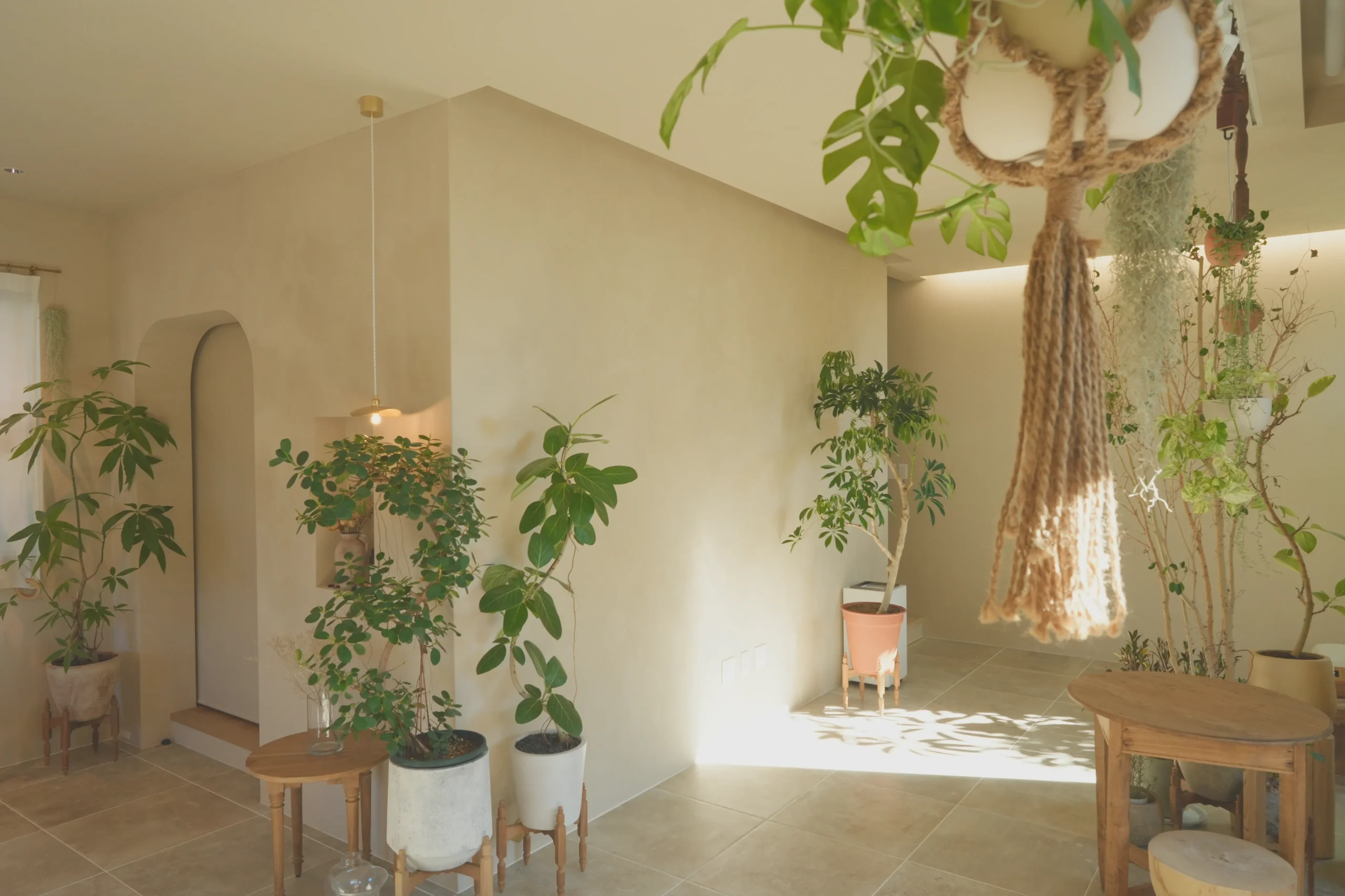
When designing our home, we obsessed over our houseplants just as much as—if not more than—our furniture and lighting.
The veins of leaves glowing in the soft morning light, shadows swaying in the breeze, and the pure joy of discovering a new sprout. Living closely with growing plants adds such a rich, fulfilling layer to our daily lives.
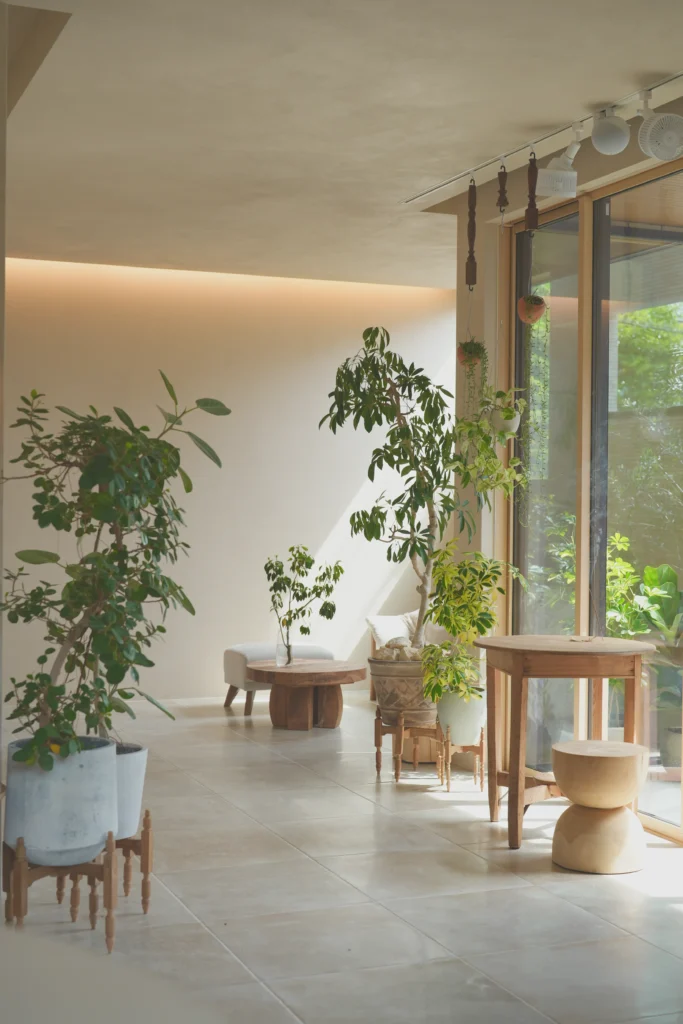
Today, I’d love to introduce the precious plants that share our home, along with my personal “ease of care” ratings (out of 5 stars) and a few care tips.
*Note: You can click the images to check out the exact pots and items I use, so I hope you find that helpful!
The Stars of the Living Room
First, let’s start with the plants that add a massive presence to our living room, where we spend the majority of our day.
Schefflera Angustifolia
Ease of Care: ★★★★★
The largest plant in our house, acting as our symbol tree, is the “Schefflera Angustifolia.”
I fell in love at first sight with its dynamic, powerfully branching silhouette at the plant shop.
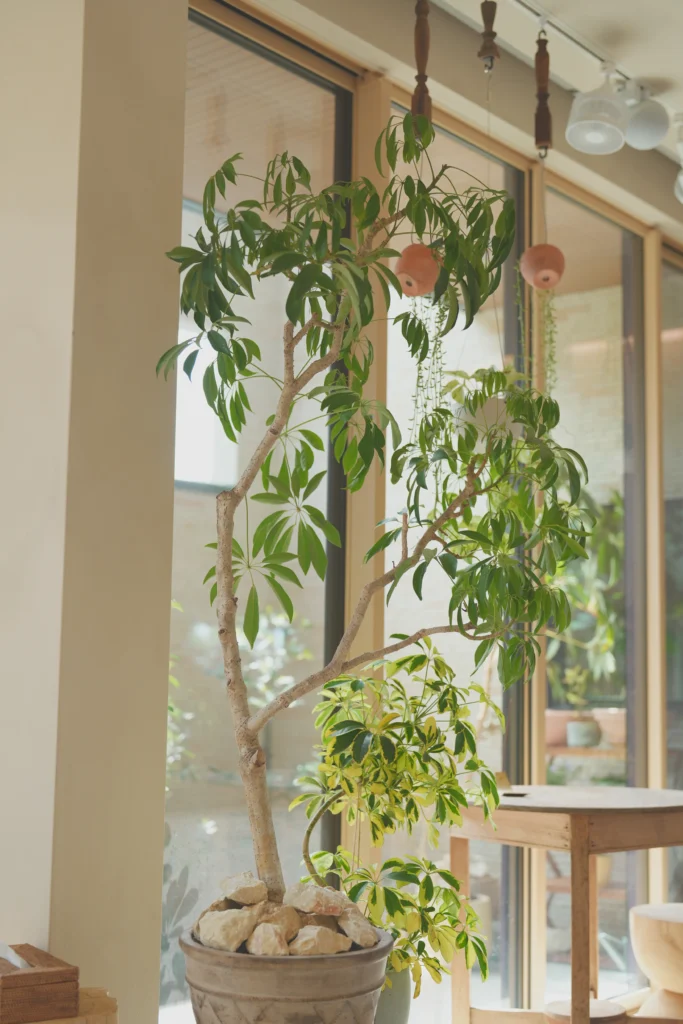
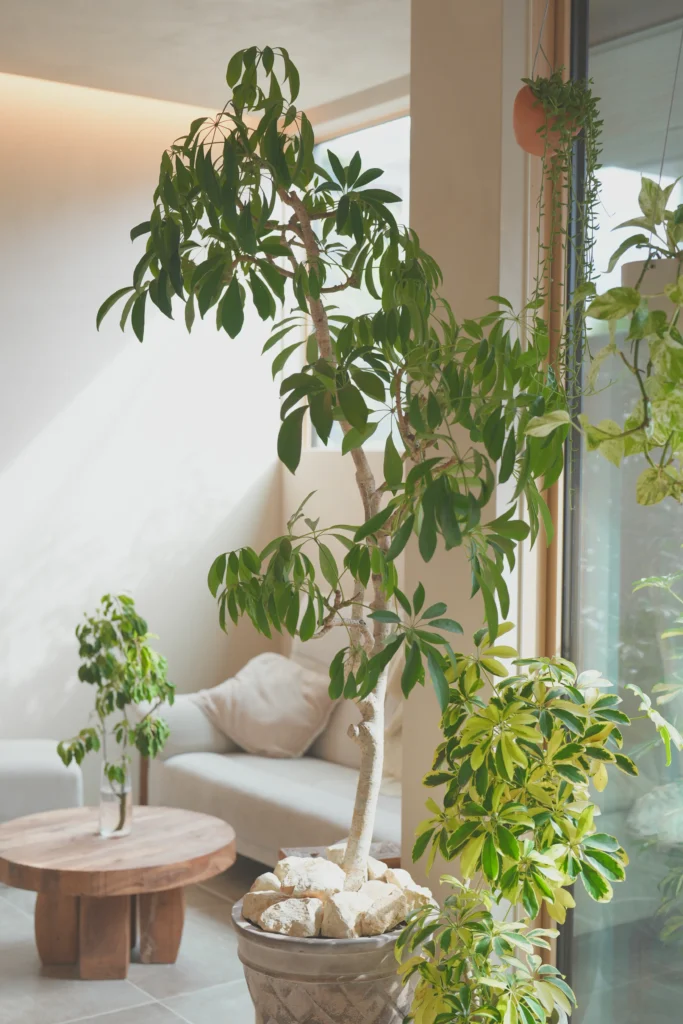
Plants in the Schefflera family are incredibly resilient.
They grow vigorously and thrive even in indoor environments.
Just give it a good soak when the surface of the soil dries out, and it will reliably keep extending its branches and leaves.
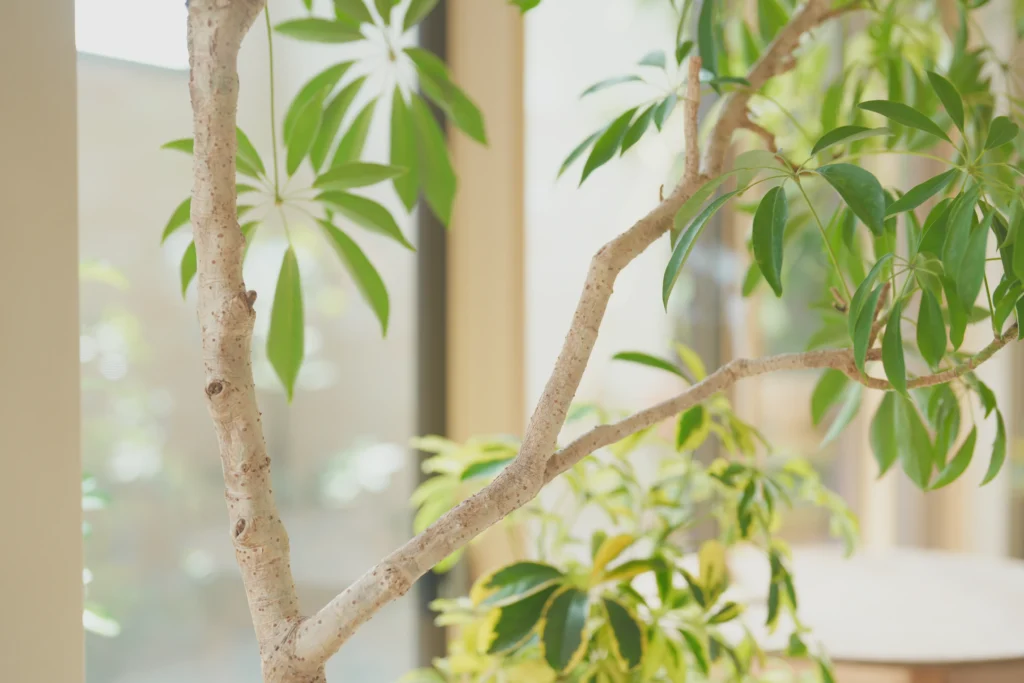
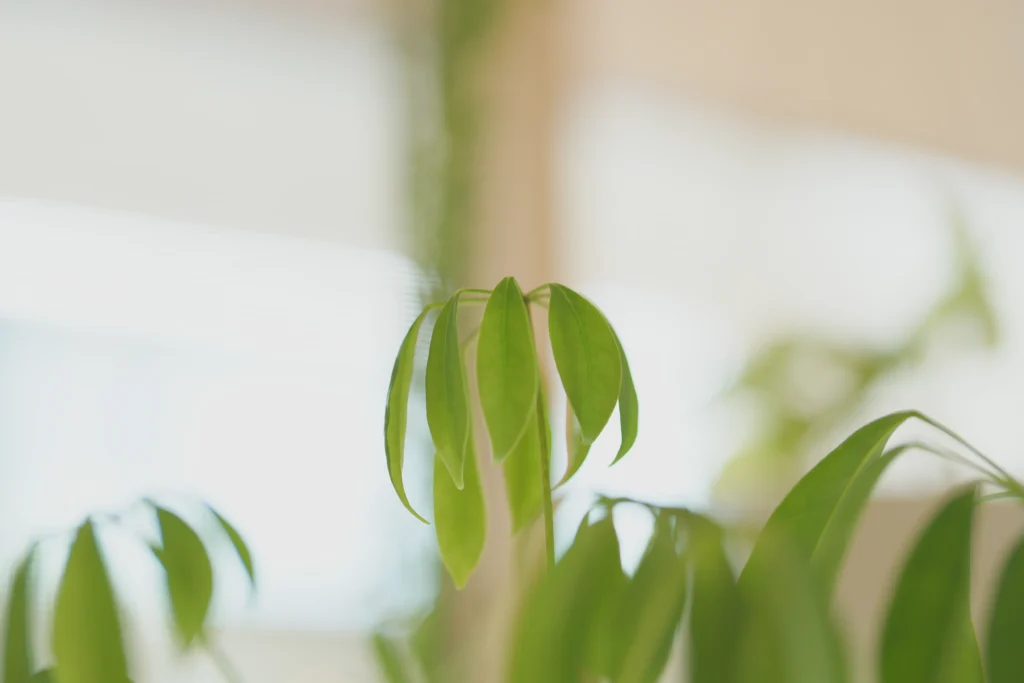
We placed decorative yellow rocks (Yellow Stone) around the base of the trunk to match the overall vibe of the room.
Happy Yellow (Schefflera)
Ease of Care: ★★★★☆
Another member of the Schefflera family, “Happy Yellow,” sits proudly on either side of the windows leading out to the courtyard.
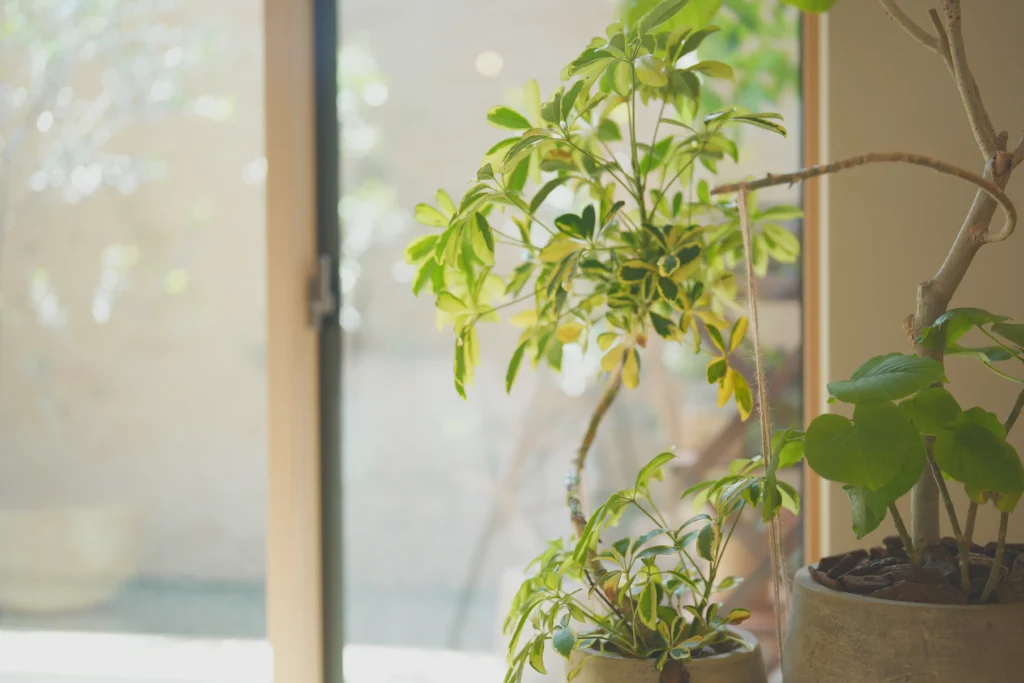
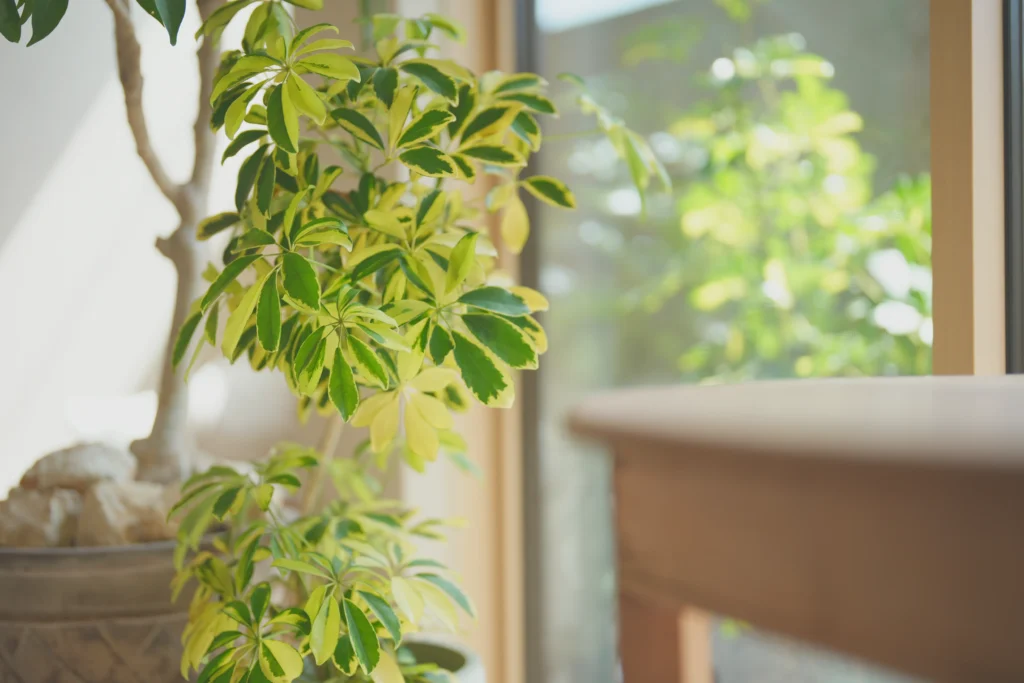
True to its name, the bright yellow variegated leaves instantly brighten up the space.
The trunk of the Happy Yellow is quite soft and pliable, so it’s really fun to bend and train it into your desired shape.
We’re actually using jute twine to shape ours right now.
Ficus Umbellata
Ease of Care: ★★★★★
This is the oldest plant in our house; it’s been with us for five years now.
The large heart-shaped leaves are adorable, making it a classic plant that fits perfectly into any interior.
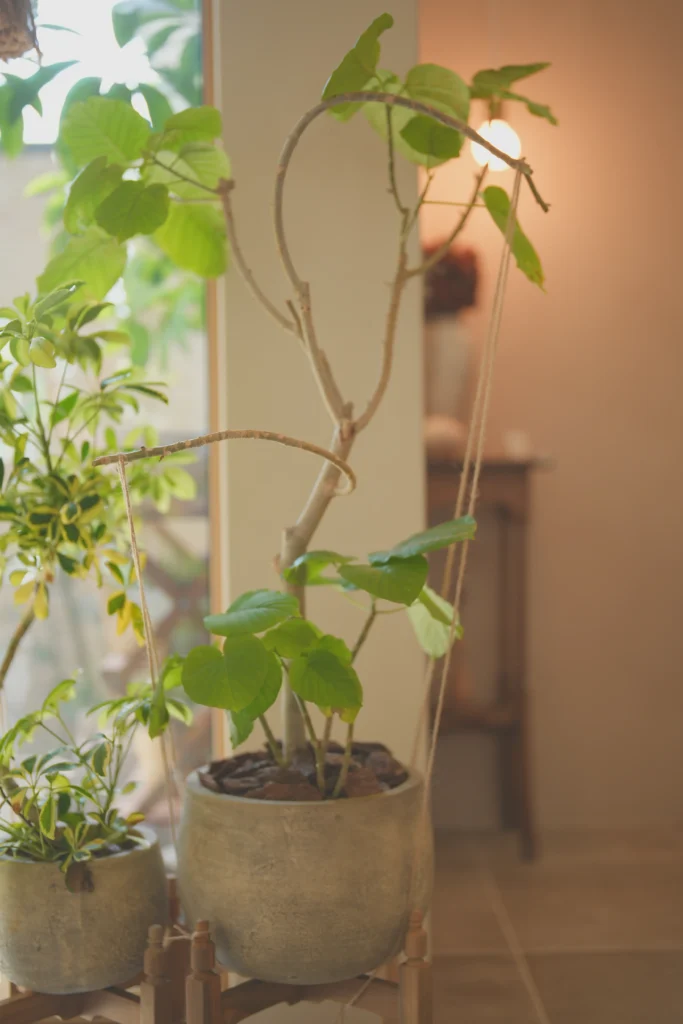
Because the Umbellata grows so fast, we prune it back pretty hard every spring to summer to maintain its shape. If you stick the pruned branches in a flower vase with water, they sprout roots in no time. Watching little jars of Umbellata multiply all over the house is one of my favorite things. In terms of ease of care, it’s number one.
Just like the Schefflera, if you leave an Umbellata alone, it will shoot straight up.
Because of that, it’s fun to chop the top off to encourage branching, or use twine and special tools to bend it.
I wanted to play around with it a bit this year, so I’m currently using jute twine to pull the branches and train them into a curved shape.
Audrey and Panda (Banyan)
Our rubber tree (Ficus) family members are also thriving in the living room.
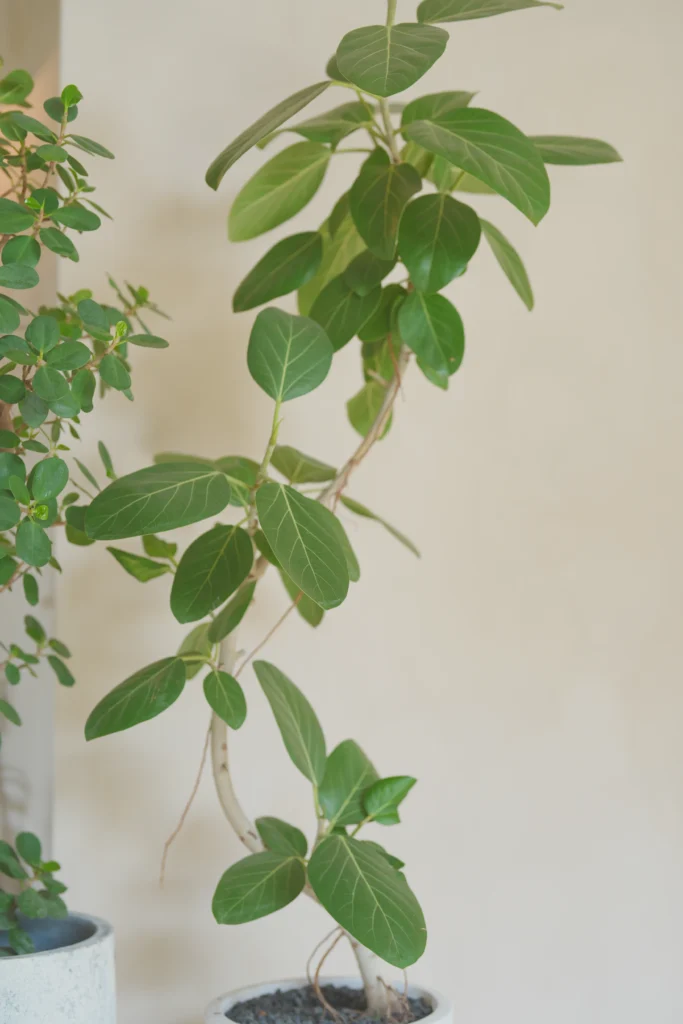
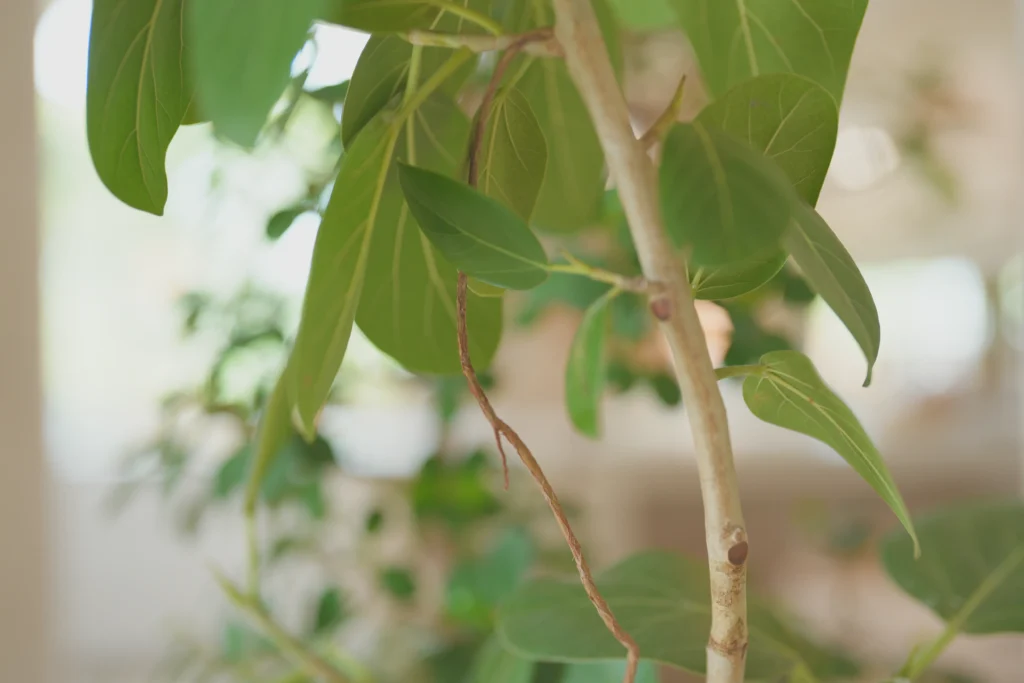
Ficus Benghalensis ‘Audrey’ (Ease of Care: ★★★★★)
This one has a trained curved shape and tons of “aerial roots” that give it a lot of character.
It doesn’t drop its leaves during winter, and watching the aerial roots grow day by day is super rewarding.
It’s less prone to getting leggy than a standard Benghalensis and sprouts new growth beautifully, so I highly recommend this variety.
It’s a bit rare, but beginners might actually have a higher success rate choosing this over a regular Benghalensis!
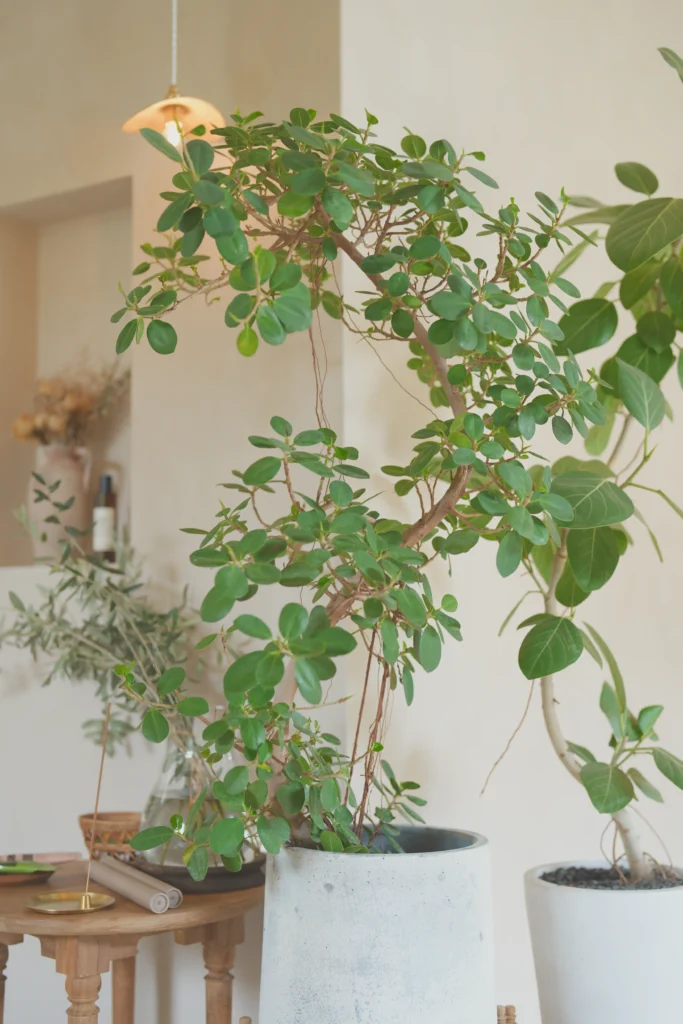
Ficus Microcarpa ‘Panda’ (Ease of Care: ★★★★☆)
The Panda Banyan is famous for its round leaves and a dynamic, almost bonsai-like shape.
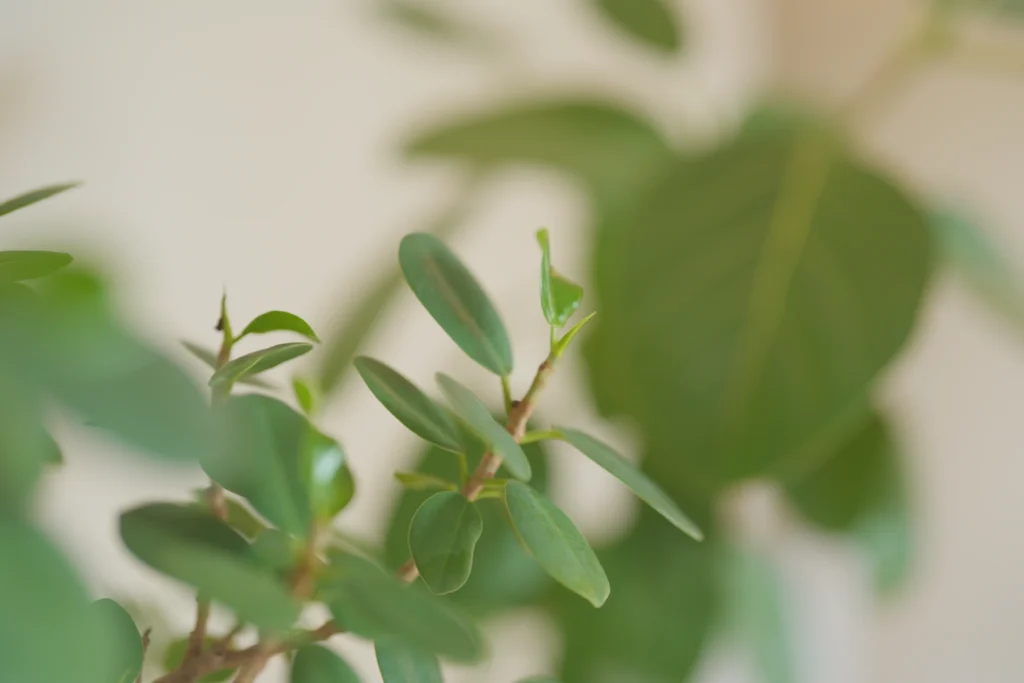
I actually grew a Panda Banyan in the past, but that one had a very finicky personality and would drop leaves the moment I let my guard down. However, our current one grows vigorously and rarely drops leaves. It truly makes me realize that plants, just like humans, have individual “personalities” and differences.
The Hanging Squad That Adds Dimension
Hanging greenery suspended from the ceiling or high places instantly adds a three-dimensional depth to any space.
String of Dolphins & String of Almonds (Ease of Care: ★★★★★)
These are trailing succulents shaped like tiny dolphins and almonds.
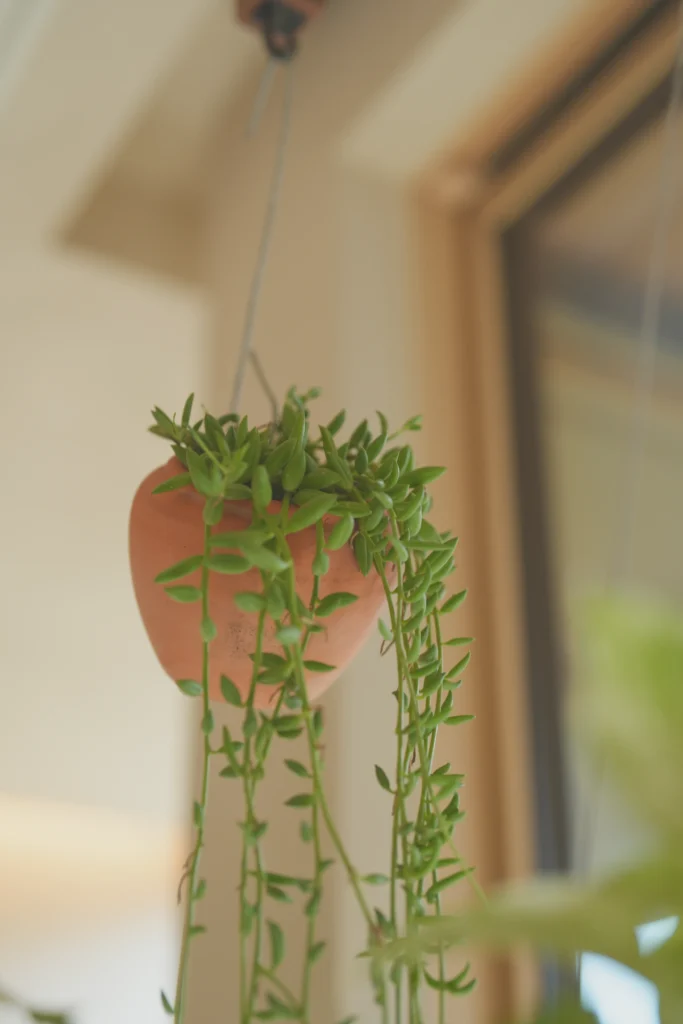
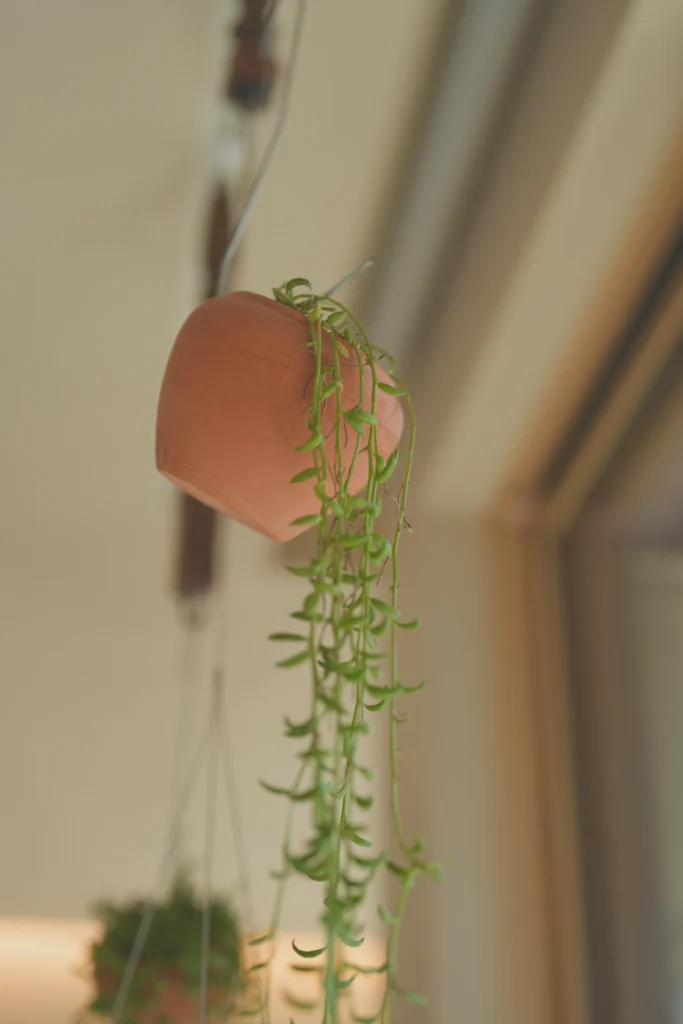
I fell in love at first sight with how they look paired with these chubby, urn-like terracotta pots.
Because they’re succulents, watering them just once every few weeks is plenty. Basically, if you leave them alone, they just keep growing.
The round “String of Pearls” is probably the most common, but these crescent moon-shaped ones are incredibly cute and highly recommended!
Pothos (Ease of Care: ★★★★☆)
I had some trauma from killing one back in our apartment days and avoided them for a long time, but I decided to give it another try.
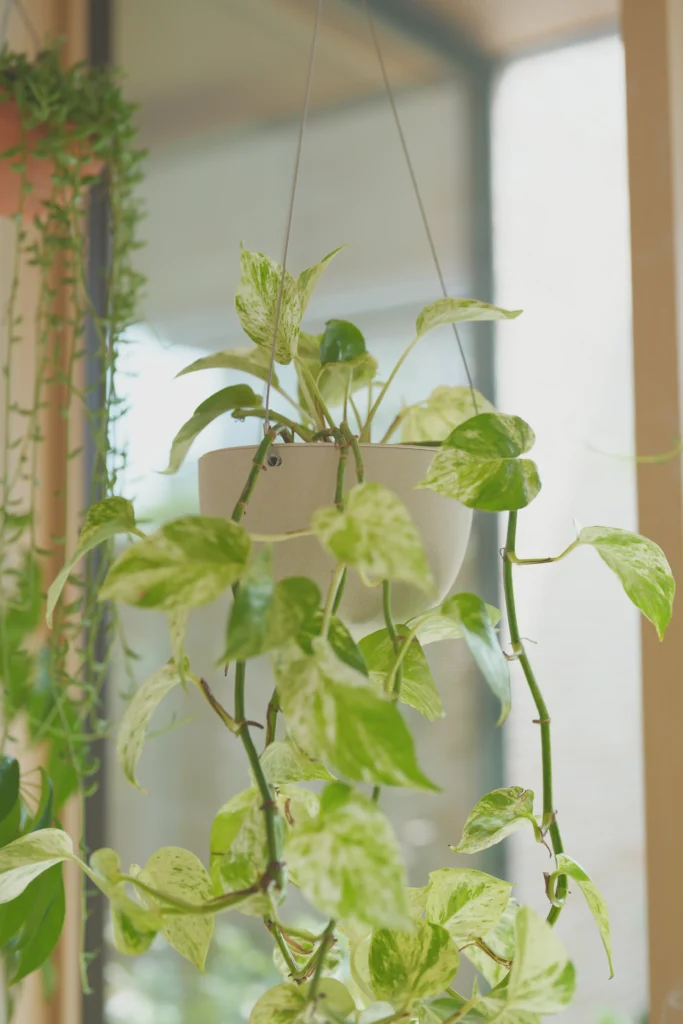
Compared to the others, it gets thirsty a lot faster, so it takes a bit more effort.
However, when the leaves start to droop slightly, that’s your sign to water. Once you get used to it, the timing is super easy to read, and watching it thrive is really fun.
Rhaphidophora Tetrasperma “Mini Monstera” (Ease of Care: ★★★★★)
I used to grow a regular Monstera in our apartment, but its leaves shot out aggressively in every direction, making it really hard to find a good spot for it.
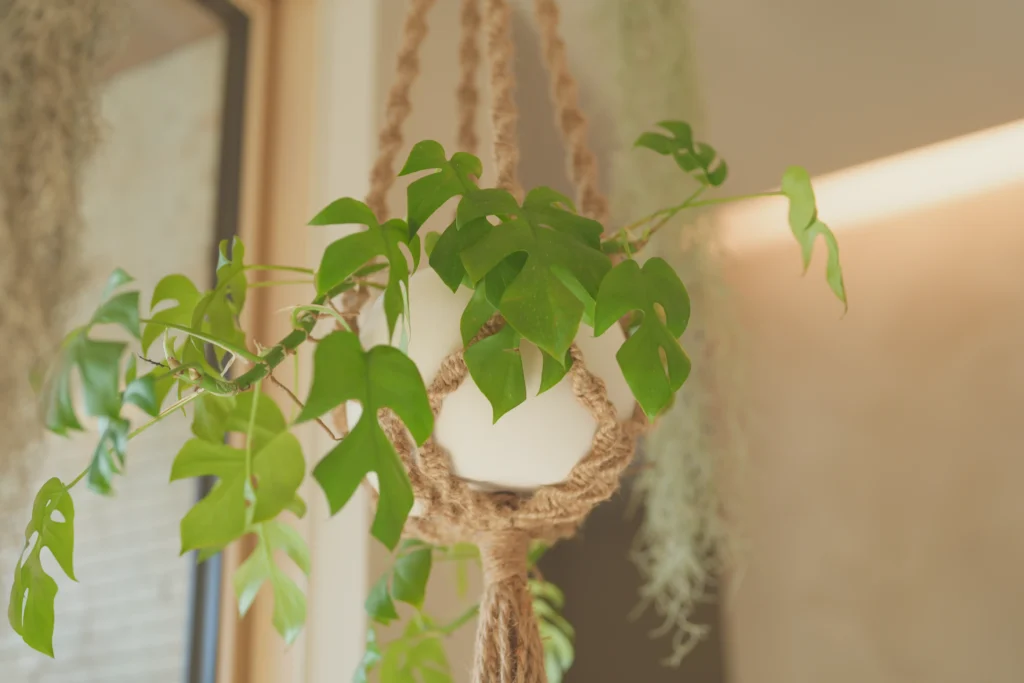
I thought, “Why not just hang it then?” and brought home this Mini Monstera.
The leaves are smaller but still feature those iconic splits, and they grow dynamically, making it perfect for a hanging planter!
It grows vigorously and is very easy to care for.
When hanging plants from the ceiling, these wooden hooks are a lifesaver. They are antique-style products lathed from old wood, and because they are entirely handmade, each one has a unique expression.
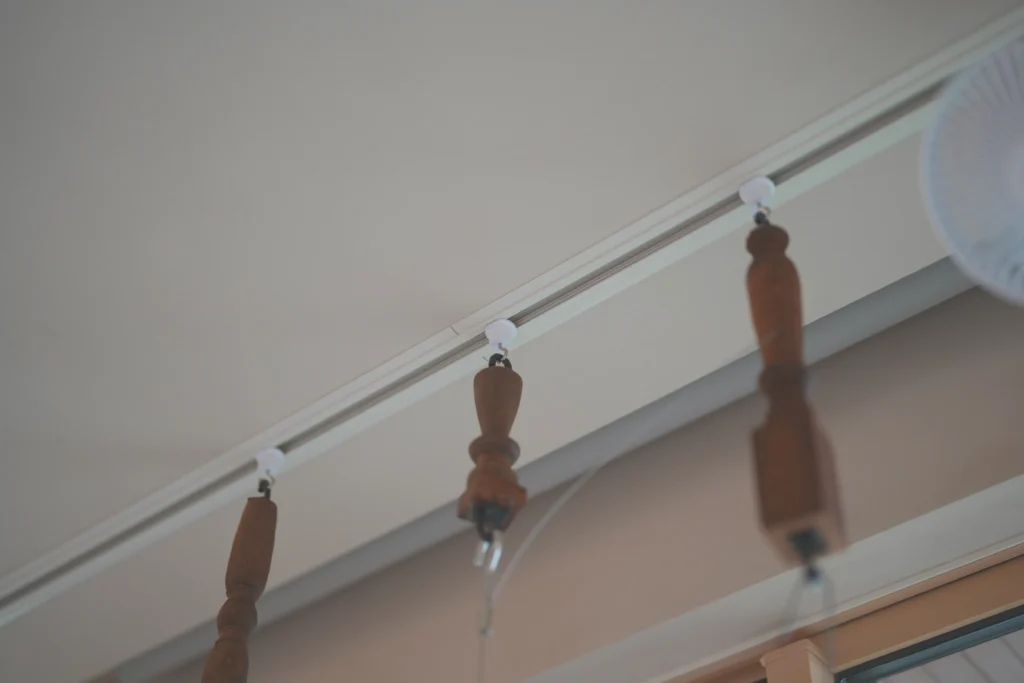
We bought three different sizes and varied their heights to create a nice rhythm in the room.
Plants Coloring the Courtyard
Next up are the large plants we are growing in the courtyard, where they can feel the fresh outdoor air.
Gold Capella
Ease of Care: ★★★★☆
Looking quite similar to the Happy Yellow, the Gold Capella is another variety of Schefflera with cute yellow variegation.
We picked up a multi-trunked specimen.
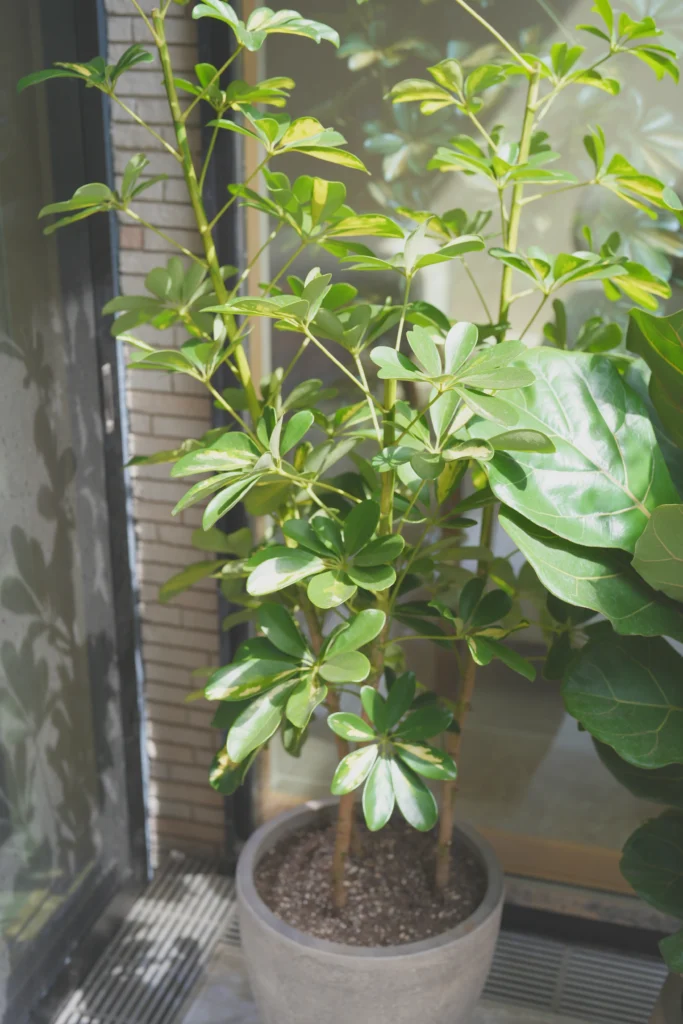
Unlike the Happy Yellow, it grows straight upwards.
To keep it from looking too monotonous, we’ve chopped off the top and are currently encouraging it to branch out.
Ficus Lyrata (Fiddle Leaf Fig)
Ease of Care: ★★★★☆ (Waiting to grow)
Also known as the Fiddle Leaf Fig. It’s a new addition we just brought home this year.
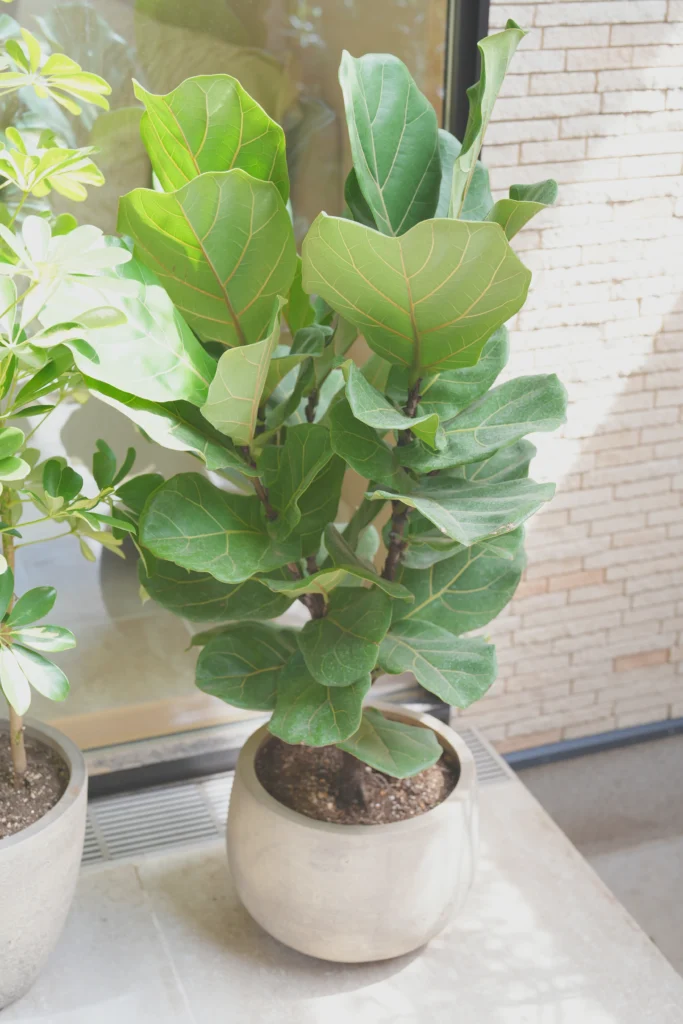
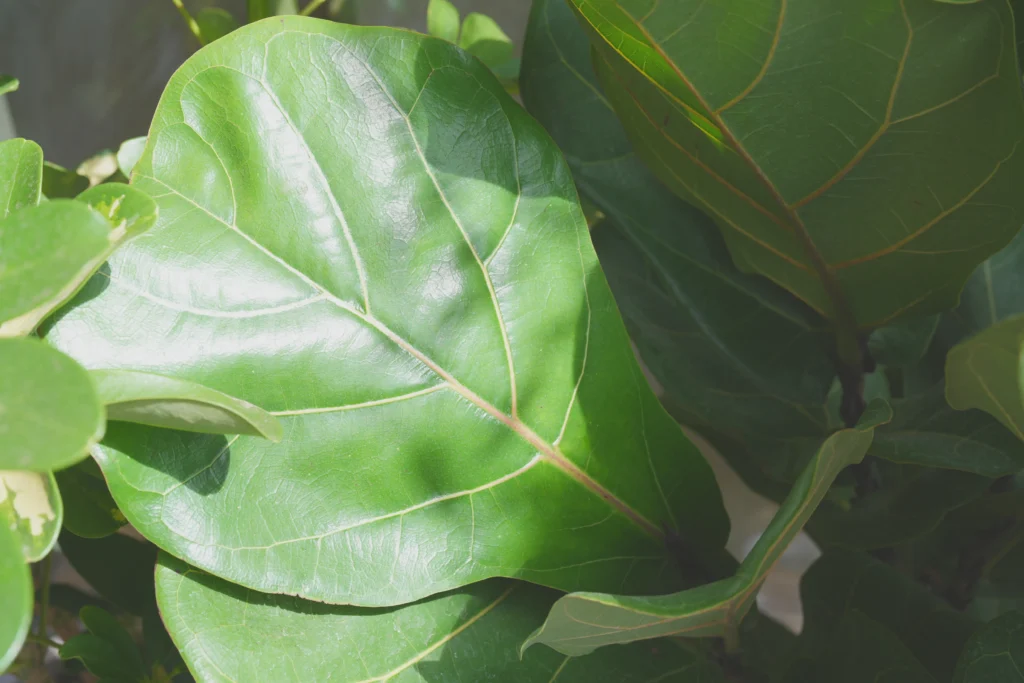
I honestly wanted a fully grown, large plant from the start,
but I couldn’t find one with my ideal shape, so I decided to grow it myself from a small plant.
Its growth speed is quite slow, so waiting patiently for it to stretch out can be a bit frustrating.
I watch its daily progress, dreaming of the day those large, wavy leaves spread out dynamically.
Tupidanthus & Ficus Altissima
The second largest plant in our house is the Tupidanthus, a relative of the Schefflera (Ease of Care: ★★★★☆).
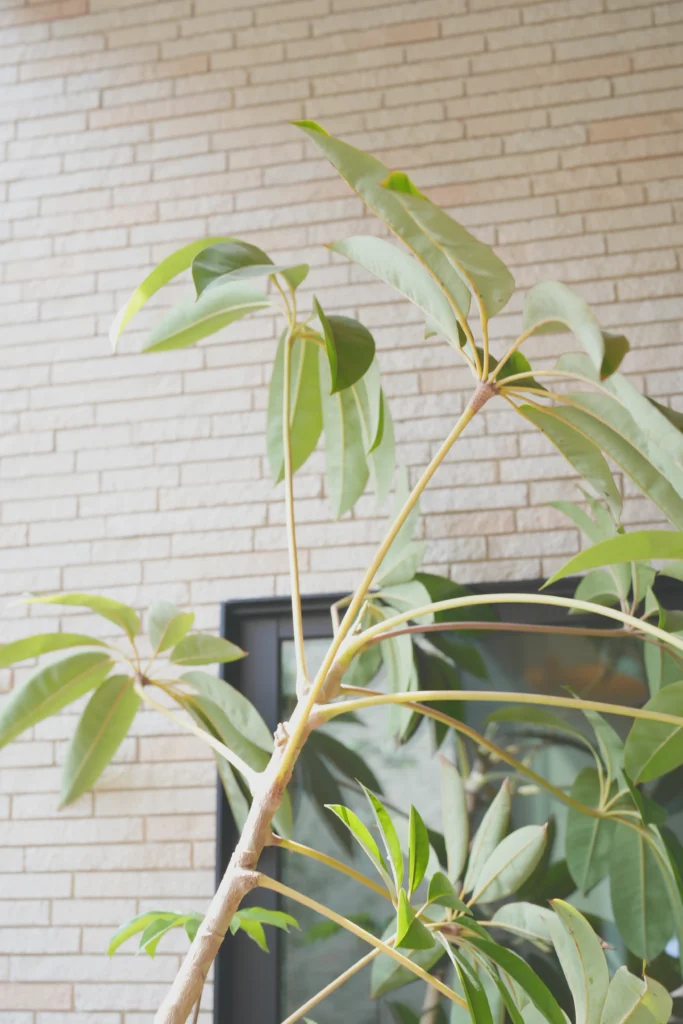
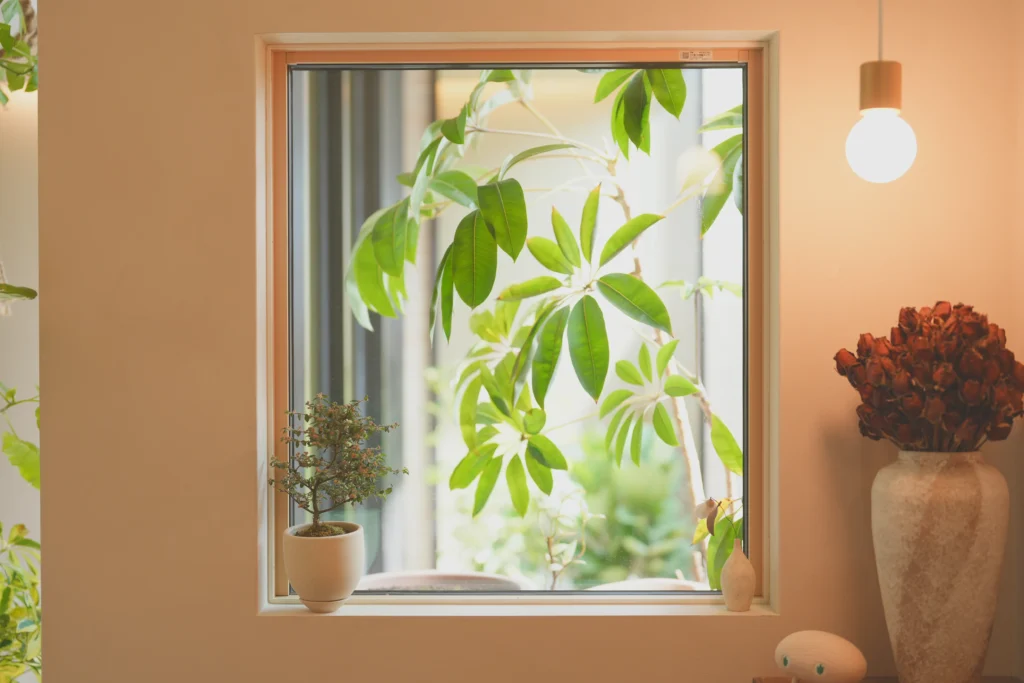
Characterized by its large, glossy leaves, it’s a stellar student that grows rapidly.
One of its charms is that it naturally curves as it grows.
However, it can sometimes curve in completely unexpected directions, and ours is currently leaning heavily to one side.
To correct this, we are constantly rotating the pot so the sun hits the opposite side, fighting to balance out its growth.
Also, we bought it intending to keep it outdoors, but apparently, it dislikes direct sunlight… so we are currently heavily debating where it should live permanently.
The one I’m slightly worried about is the Ficus Altissima (Ease of Care: ★★★☆☆).
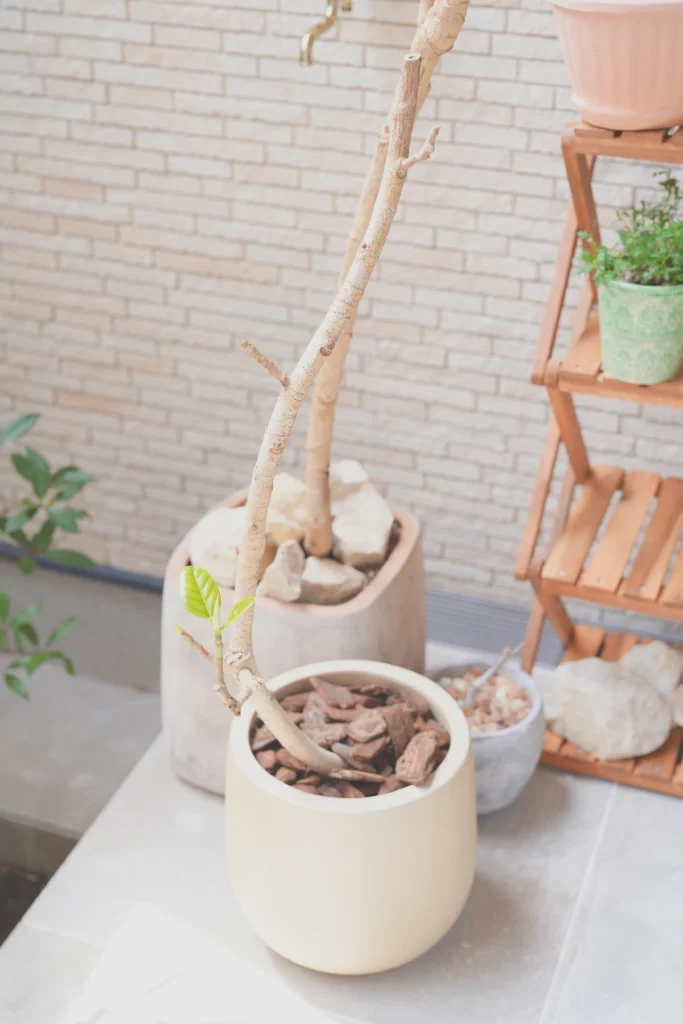
It’s a terribly cute specimen with yellow variegation and a curved trunk, but perhaps due to being exposed to the winter cold, it dropped every single one of its leaves.
I’ve taken the plunge and pruned it back hard, and it’s currently resting quietly in a warm spot while we wait for it to recover. Hang in there…!
Dining Room and Kitchen
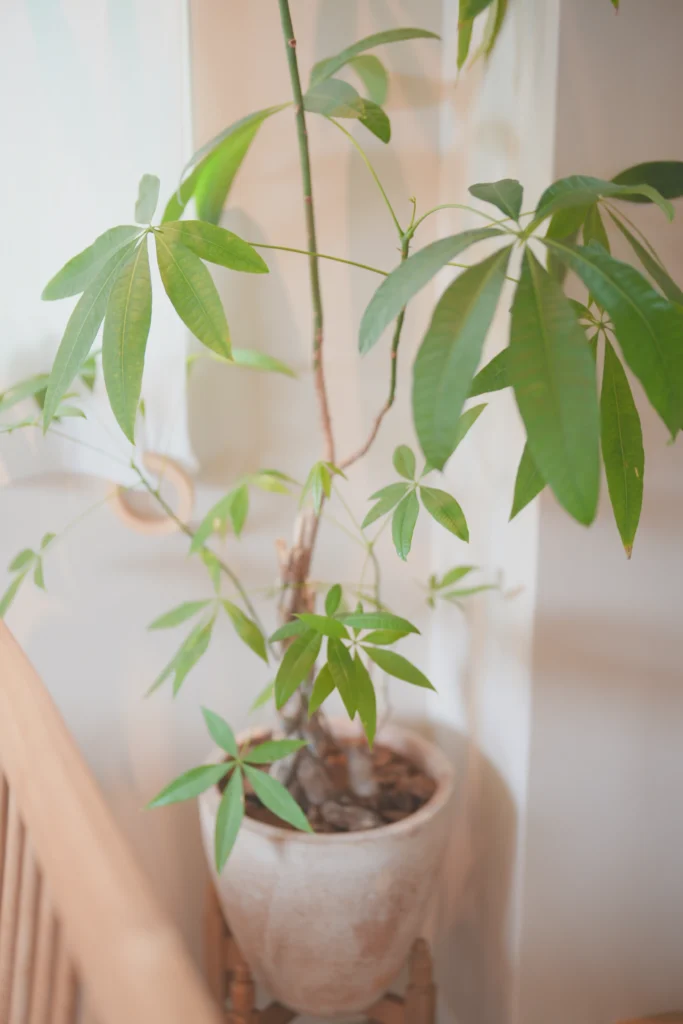
The Reliable Veteran: Money Tree (Pachira)
Ease of Care: ★★★★★
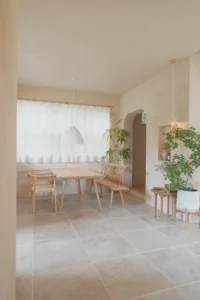
Alongside the Umbellata, this is one of our oldest residents.
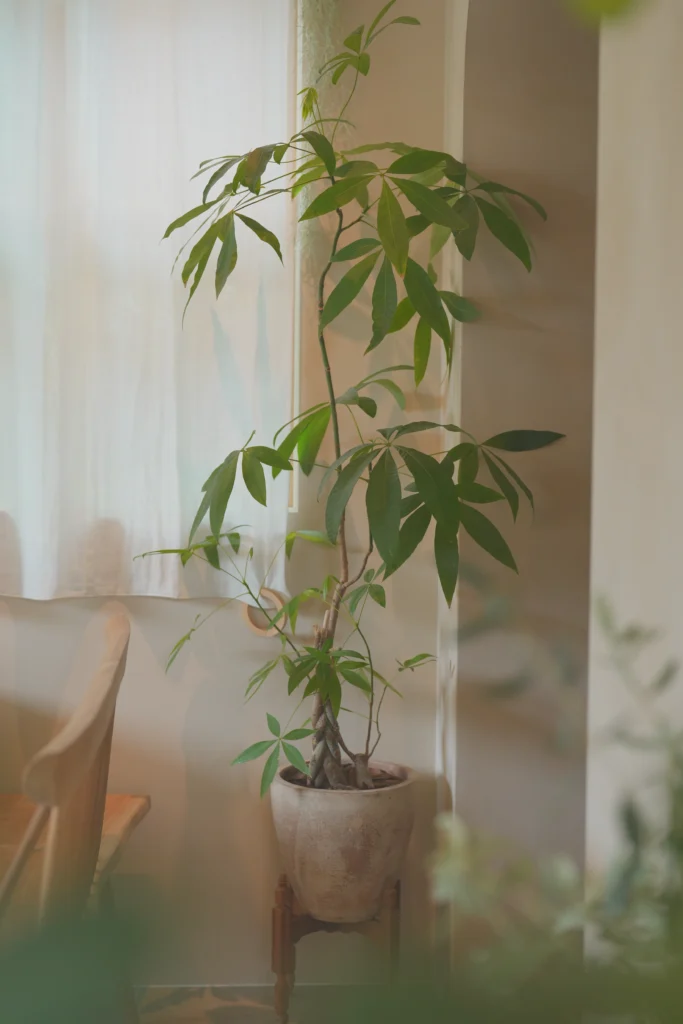
It’s highly drought-tolerant, meaning infrequent watering is fine, and it rarely drops leaves even in winter. It is truly an easy plant to care for.
Seeing bright green new shoots open up one after another is the motivation behind my daily observations.
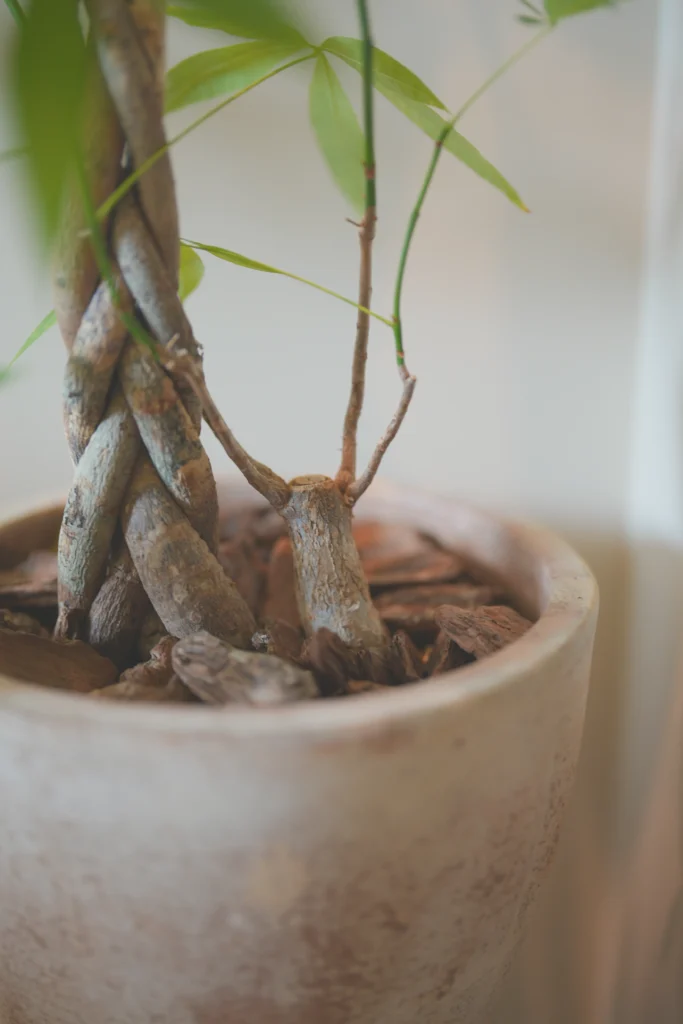
Money Trees tend to shoot straight up and easily get “leggy.” It became top-heavy, leaving the base looking a bit bare, which was a constant source of annoyance. So, in our house, we purposely planted two separate plants in the same pot to strategically add volume to the bottom section.
Little Greens in the Kitchen
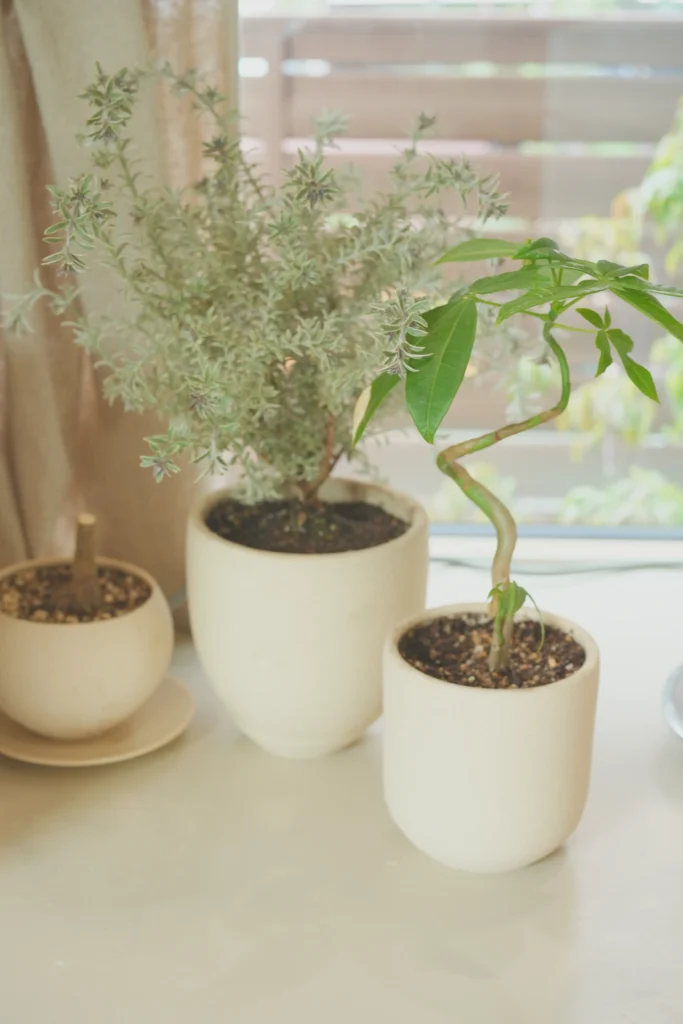
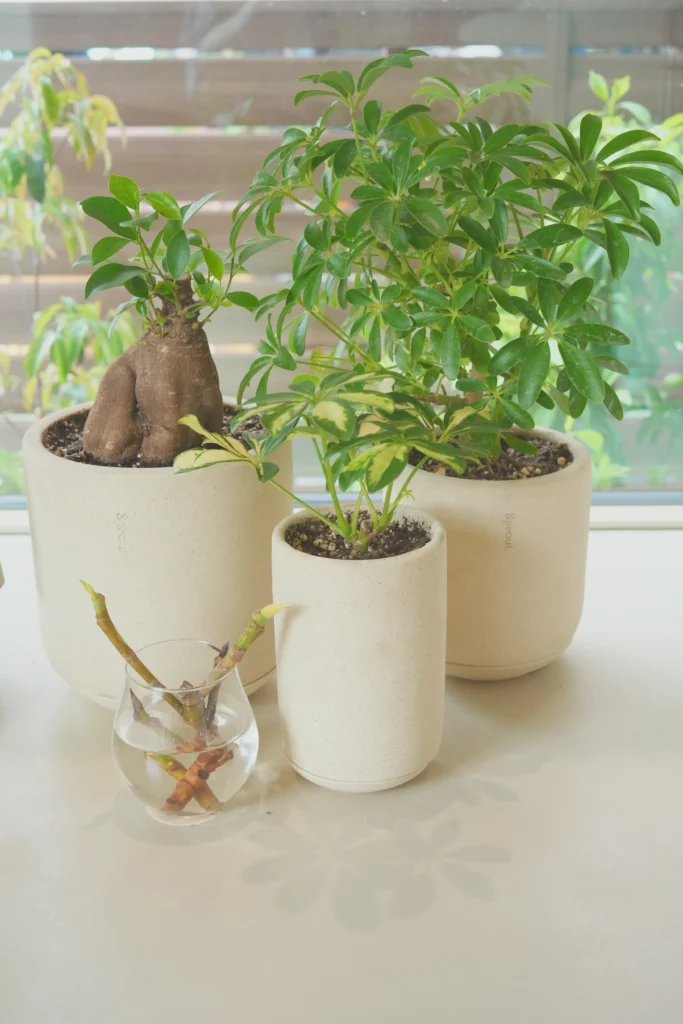
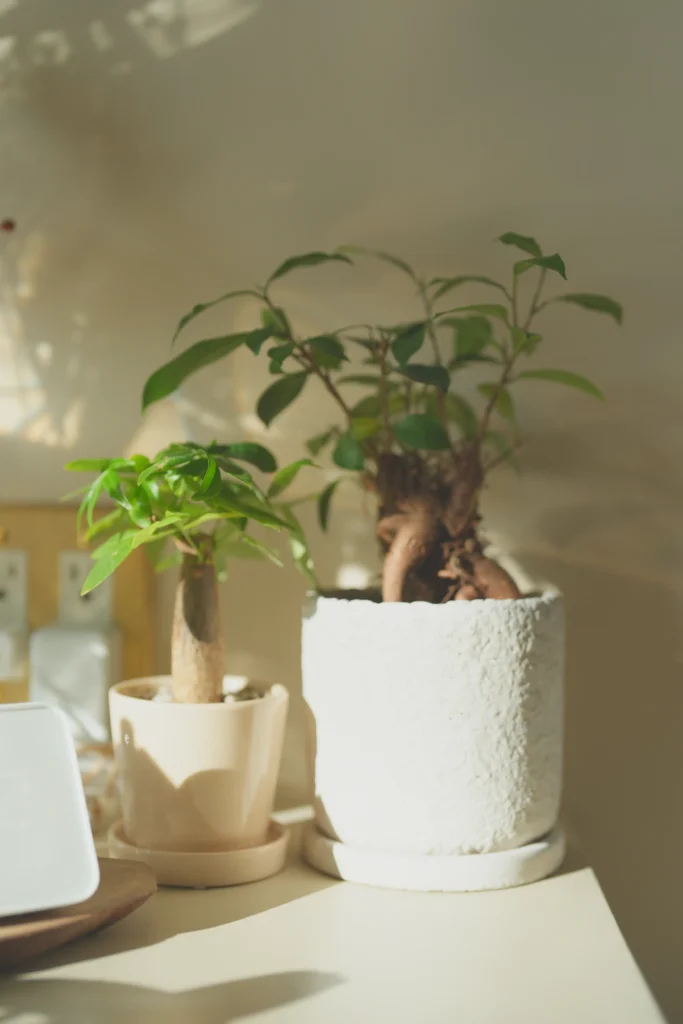
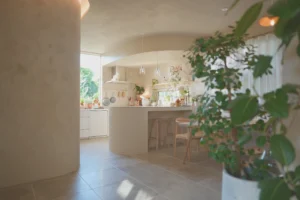
We’ve lined up small pots around the kitchen so that greenery is always in sight while cooking.
They are sturdy, low-maintenance little residents like mini Money Trees, Banyans, and Scheffleras.
Our newest addition is the Westringia ‘Smokey White’.
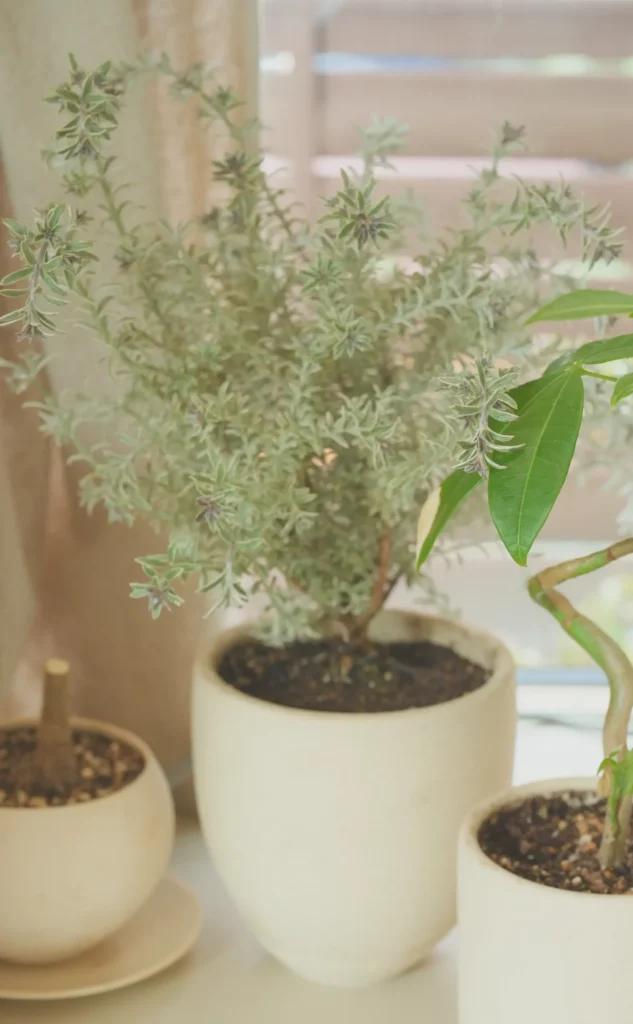
It’s a type of Australian native plant, and its delicate, powdery silver leaves are absolutely stunning.
I heard it also produces tiny flowers, so I’m already looking forward to seeing them.
Conclusion
I feel that just having a single plant in a room instantly softens the atmosphere.
Watering and misting them according to their unique personalities takes a little bit of effort, but they provide so much healing and enrich our lives far beyond that effort. They are precious members of our family.
If you’re thinking, “I want to grow plants, but I don’t have the confidence,”
please try bringing home one of the ★5 ease-of-care plants first!
\ Items to Brighten Up Your Life with Plants /


Comments