
*This post contains affiliate links.
Hi everyone, it’s Twilife.
The “cabinet fronts” heavily influence a kitchen’s overall look, while the “internal storage” directly impacts your daily cooking efficiency.
However, both of these are incredibly hard to gauge just by looking at a catalog.
We visited showrooms countless times, weighing our options over and over.
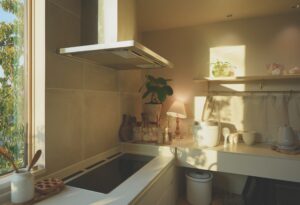
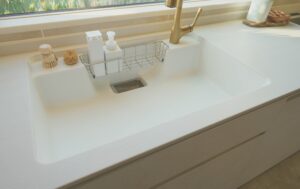
We ultimately chose the Panasonic L-Class Kitchen.
Today, I’ll be sharing a completely honest review of the cabinet fronts we meticulously selected—the “Arco 50 Series (Stucco White)”—focusing on its texture and the handleless design. I’ll also share our unfiltered thoughts on the “standard internal storage modules” after months of actual use.
I hope this helps anyone currently considering an L-Class kitchen!
Stucco White & Handleless: Blending into the Space
First, let’s talk about the exterior look and usability of the cabinet fronts.
Erasing the “Mass-Produced” Feel with a Muted White
Honestly, we initially wanted to unify the entire kitchen in beige tones to match our living room.
However, we couldn’t find a single mass-market kitchen manufacturer that offered our ideal shade of beige.
(This is actually the main reason we opted for a custom-built section for part of our open-concept kitchen!)
So, for the system kitchen portion, we searched for a color that “wouldn’t demand attention, but quietly blend into the space.”
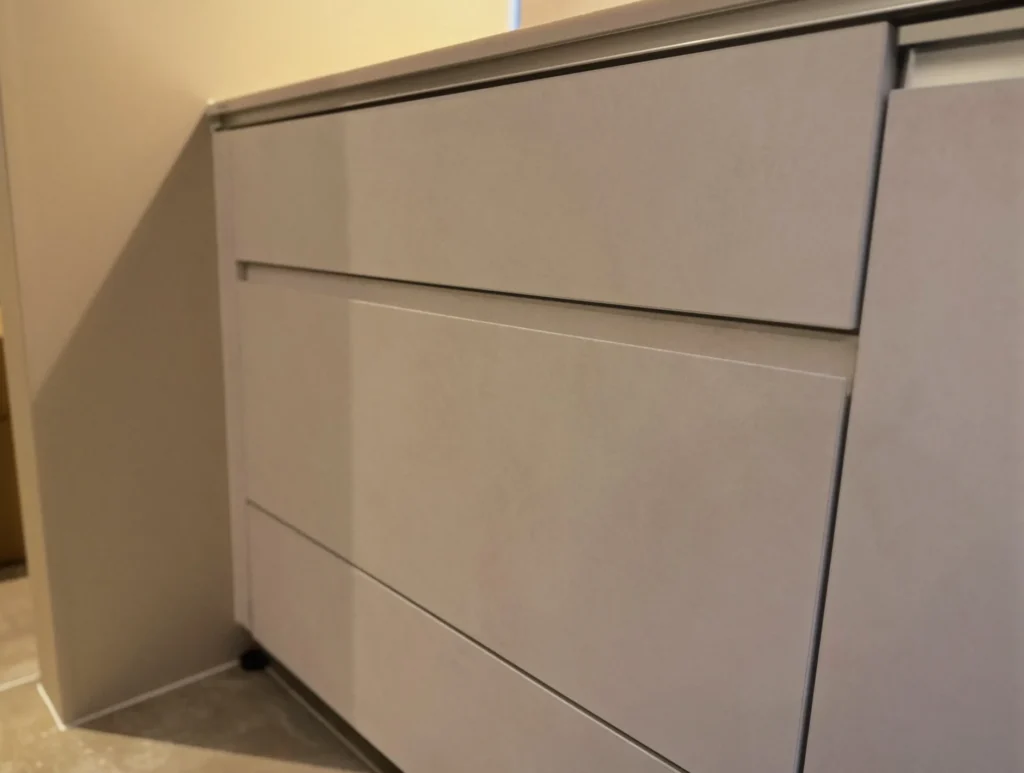
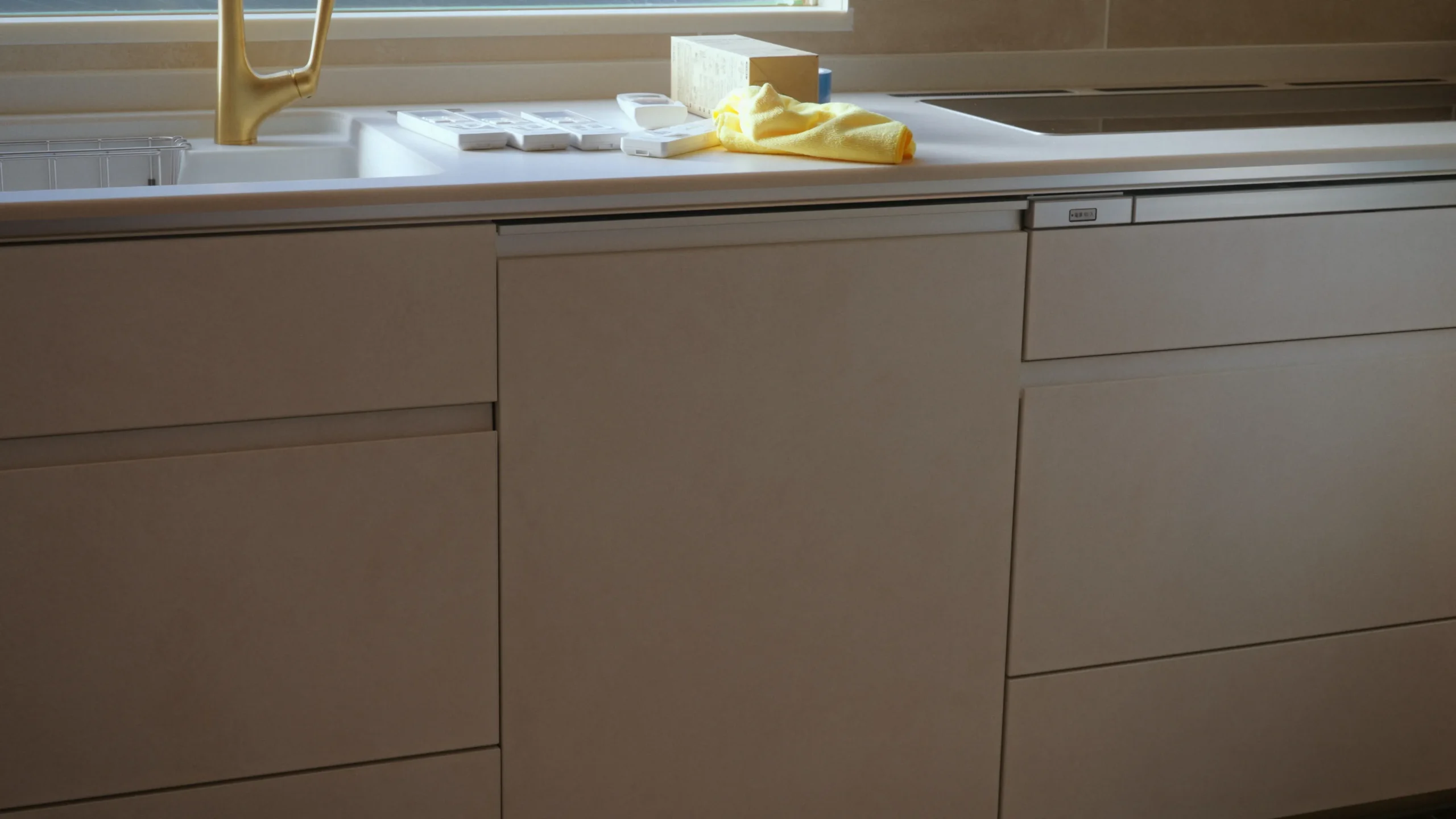
We finally landed on the Arco 50 Series in “Stucco White.”
Rather than a stark, bright white, it’s a “muted white” with a subtle texture.
This turned out to be the perfect choice, blending beautifully without clashing with the overall vibe of our living and dining area.
The Magic of Handleless: Open from Anywhere
The Arco series is one of the very few “handleless design” options available in the L-Class cabinet lineup.
While it undeniably looks sleek and beautiful, the biggest practical benefit we’ve found in daily life is that
you don’t have to stand directly in front of the door to open it.
With standard handles, you’re forced to reach for the center of the drawer.
But because the handleless Arco series features a continuous groove along the entire top edge, you can easily hook your fingers and pull it open from the far corners.
We frequently cook together, and this feature is an absolute lifesaver. Even if one of us is standing right in front of the stove, the other person can smoothly slide open the cabinet below from the side to grab some spices—without having to say, “Excuse me,” and push the other aside. It prevents interruptions and keeps our cooking rhythm intact. Eliminating these tiny daily frictions makes this the ultimate design choice.
What About Dirt in the Grooves?
When opting for the handleless design, our slight concern was:
“Won’t dust and grime easily build up inside the grooves?”
After using it for a while, I can say it doesn’t bother us at all.
Whenever I notice a bit of dust, I just quickly swipe a cloth or handy duster through it.
Even if flour or other cooking powders get stuck there, the shape makes it easy to wipe clean. So far, it hasn’t added any extra burden to our cleaning routine.

A Minor Regret? The Push-Open Drawers
While we are completely thrilled with the handleless design overall, there’s one specific element that feels a bit “off.”
That would be the “push-open drawers” located under the cooktop.
Sure, popping them open with a quick nudge is handy, but when trying to close them, they often fail to latch and click into place unless pushed in a very specific way.
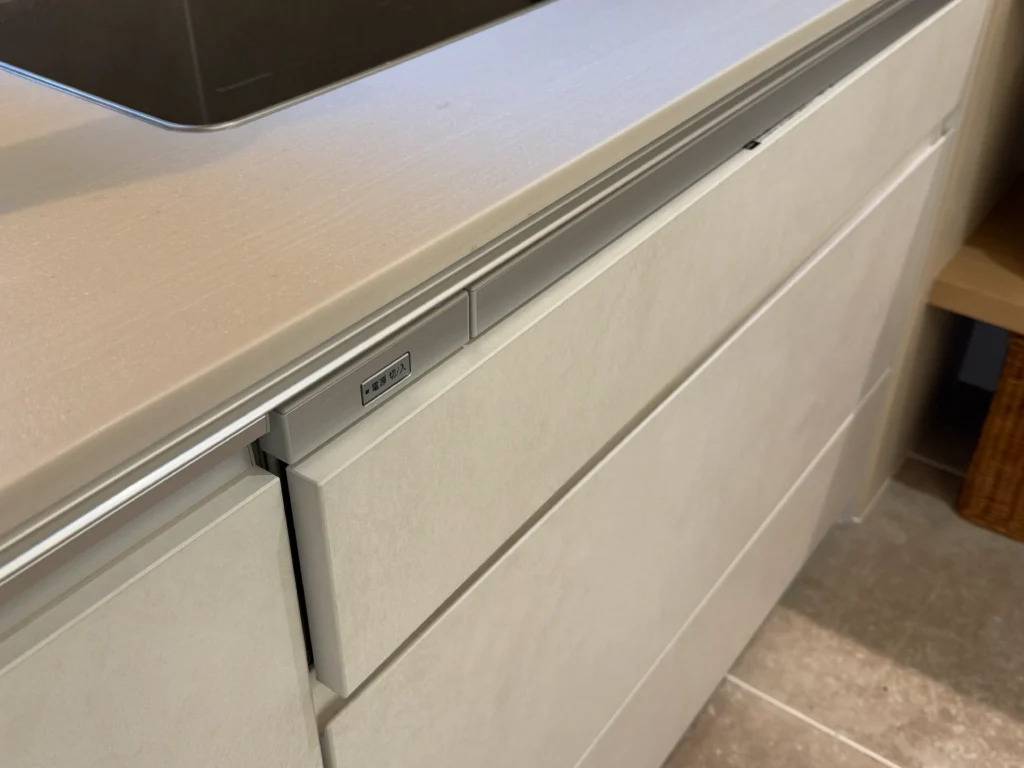
It might just be because we’ve stuffed them too full, but it makes me wonder if we should have just stuck with standard, non-push drawers instead of forcing this feature.
I’m not exactly sure if you can opt-out of this specific mechanism, but I highly recommend testing the smoothness of the open/close action at a showroom—ideally by applying a little weight to simulate a full drawer.
[Caution] Our Honest Thoughts on the Standard Internal Storage
Now, onto the “reality of storage”—the part I wanted to convey most in this article.
Panasonic kitchens feature a modular internal drawer system, coming pre-installed with several black dividers and specialized storage accessories.
The selling point is that you can freely rearrange them, but…
The sizes of our personal cookware and plates completely clashed with Panasonic’s designated module dimensions. Ironically, it resulted in less storage capacity. Ultimately, we ended up removing almost all the default parts that came with it.
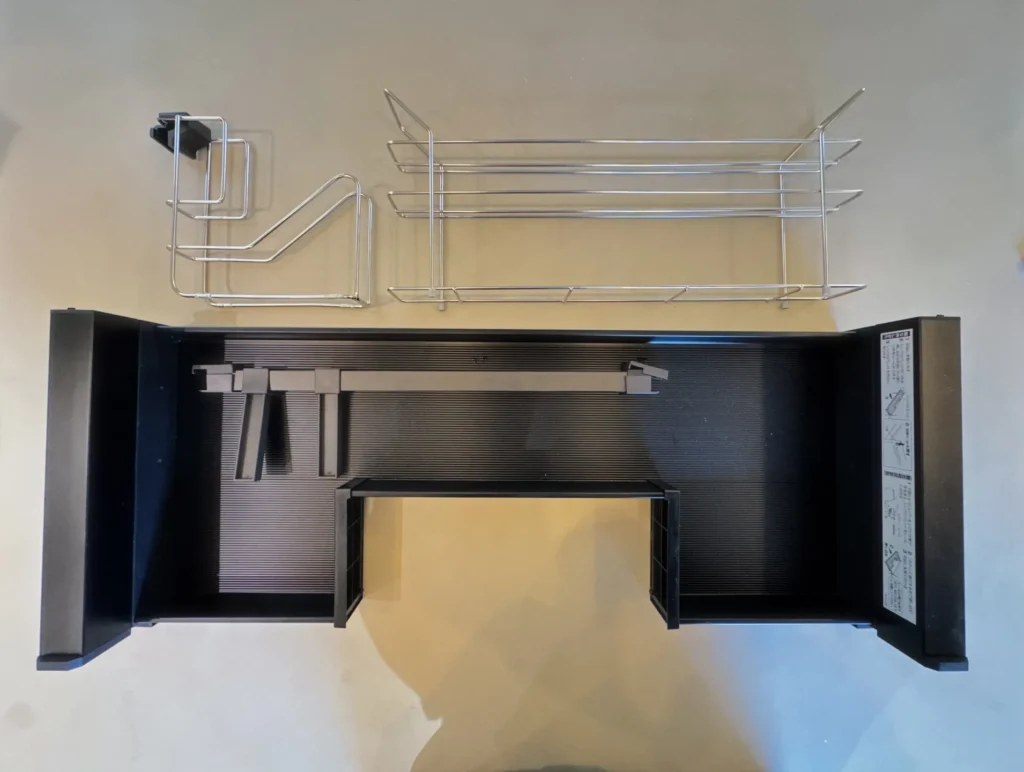
The Inconvenient Standard Parts
Here are a few specific examples of why they were hard to use:
- Pot Lid Holder: The base is weak and wobbly. It felt like a proprietary design that only perfectly accommodated a “medium-sized frying pan lid.” Any other size simply wouldn’t stand up properly.
- “Sliding Inner Tray” Under the Sink: This was the biggest bottleneck. Because there is a thin, sliding tray on the upper level, it prevents you from storing tall dishes or bottles on the bottom level. So, what do you put in the upper tray? Well, the height restriction is incredibly strict, meaning even slightly large mugs will bump into the top and won’t fit.
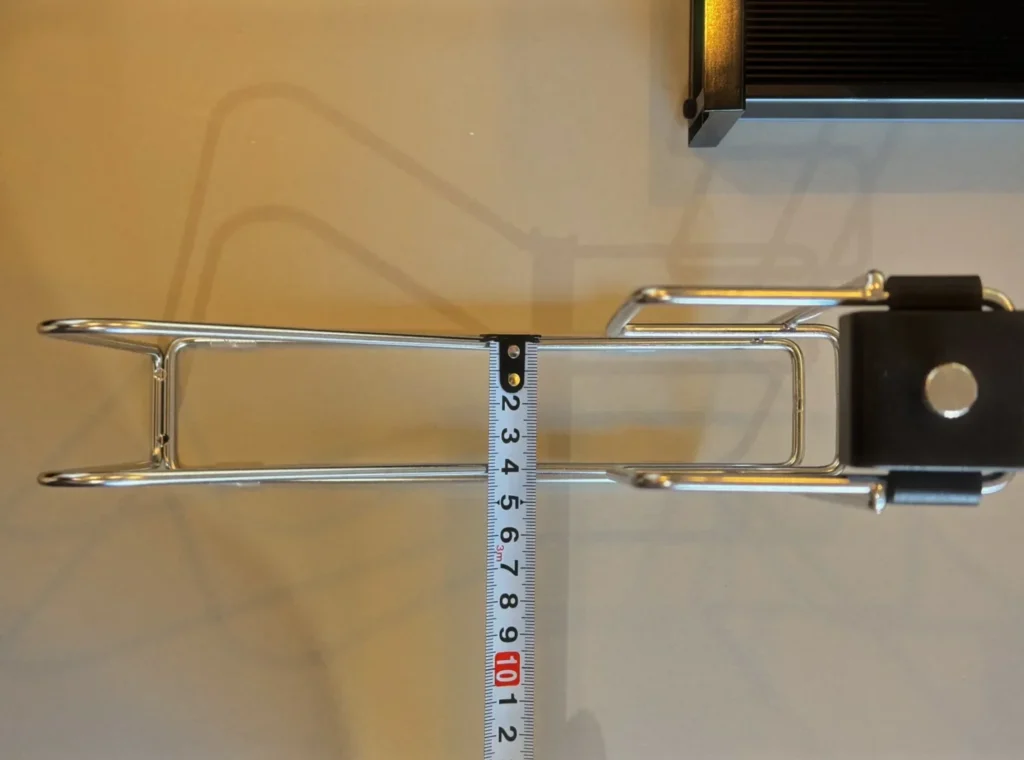
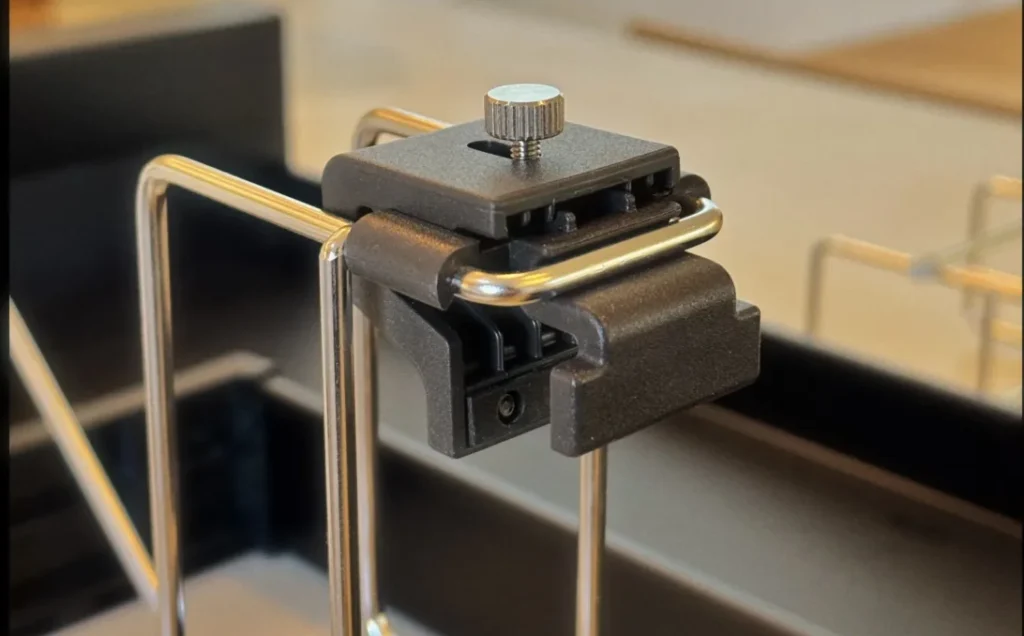
Feeling that the internal tray robbed us of storage flexibility, we made the bold decision to remove it completely.
Removing the Modules is Surprisingly Tough
*Disclaimer: Remove parts at your own risk.*
I casually thought, “Oh, I’ll just pop them out,” but removing these standard parts was actually incredibly difficult.
They are firmly secured, and while there is a procedure to remove them, the instructions are vague.
I was sweating bullets, wondering if I was doing it right or if I was going to break the kitchen itself… but I somehow managed to dismantle them.
If you are about to sign a contract for a Panasonic kitchen and know for a fact, “I will definitely not use these dividers or trays,” I strongly recommend asking your rep if the kitchen can be delivered with them already removed.
The Solution: Aftermarket Storage Racks Are Supreme
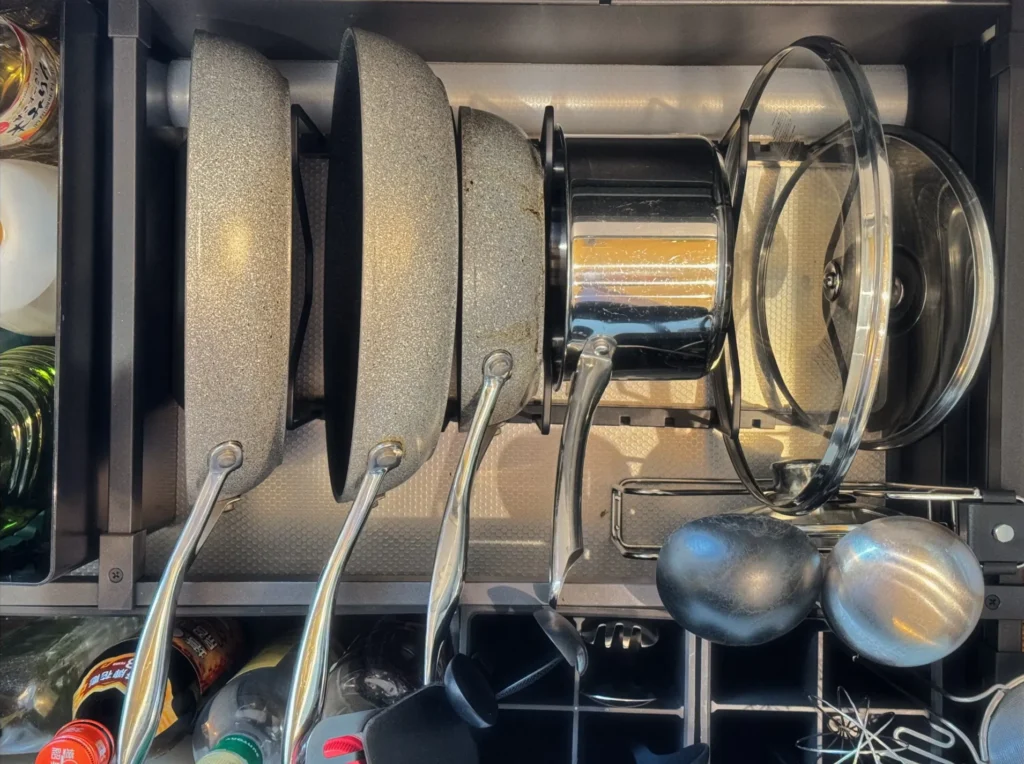
In the now-spacious drawers (sans standard modules), we line up aftermarket storage racks like Yamazaki (tower series) and Cainz storage boxes.
Both frying pans and lids, regardless of size, can now be stored perfectly upright, offering unmatched versatility.
I’ve realized that leaving enough “blank space” to flexibly adapt to your own lifestyle and belongings ultimately creates a much more user-friendly kitchen.
Truth be told, because we desperately wanted a clean, uncluttered counter kitchen, we gave up on front-facing kitchen storage. Instead, we built a pantry right next to it, opting for a storage plan that doesn’t force us to cram everything into the main kitchen unit.
We use Muji and Cainz storage boxes in the pantry to manage all our stock items in one place. Thanks to this decentralized storage, the kitchen itself is always kept spotless.
*We also cover our pantry organization in detail in our YouTube Vlog!*
By the way, Yamazaki makes another type of stand, but if you’re storing frying pans and lids, I recommend the one in the photo with sturdy dividers.
The other type of stand is better suited for storing flat plates upright.
Conclusion: The Exterior is Flawless; The Interior Takes a Little Tweaking
Today, I reviewed the L-Class kitchen’s cabinet fronts and internal storage.
I can recommend the Stucco White color and the beautiful handleless design with absolute 100% confidence!
However, regarding the internal storage, it was a good lesson that a manufacturer’s “helpful” features (like standard modules) don’t always equate to the right answer for everyone.
I consider the kitchen to be a crucial partner that you rely on every single day.
Customizing not just its exterior beauty, but even the insides of the drawers to perfectly fit your needs—that process might just be the best part of building a custom home.
\ Read our full review of the L-Class Kitchen, including the cooktop and countertops /


Comments