*This post contains affiliate links.
Hi everyone, it’s Twilife.
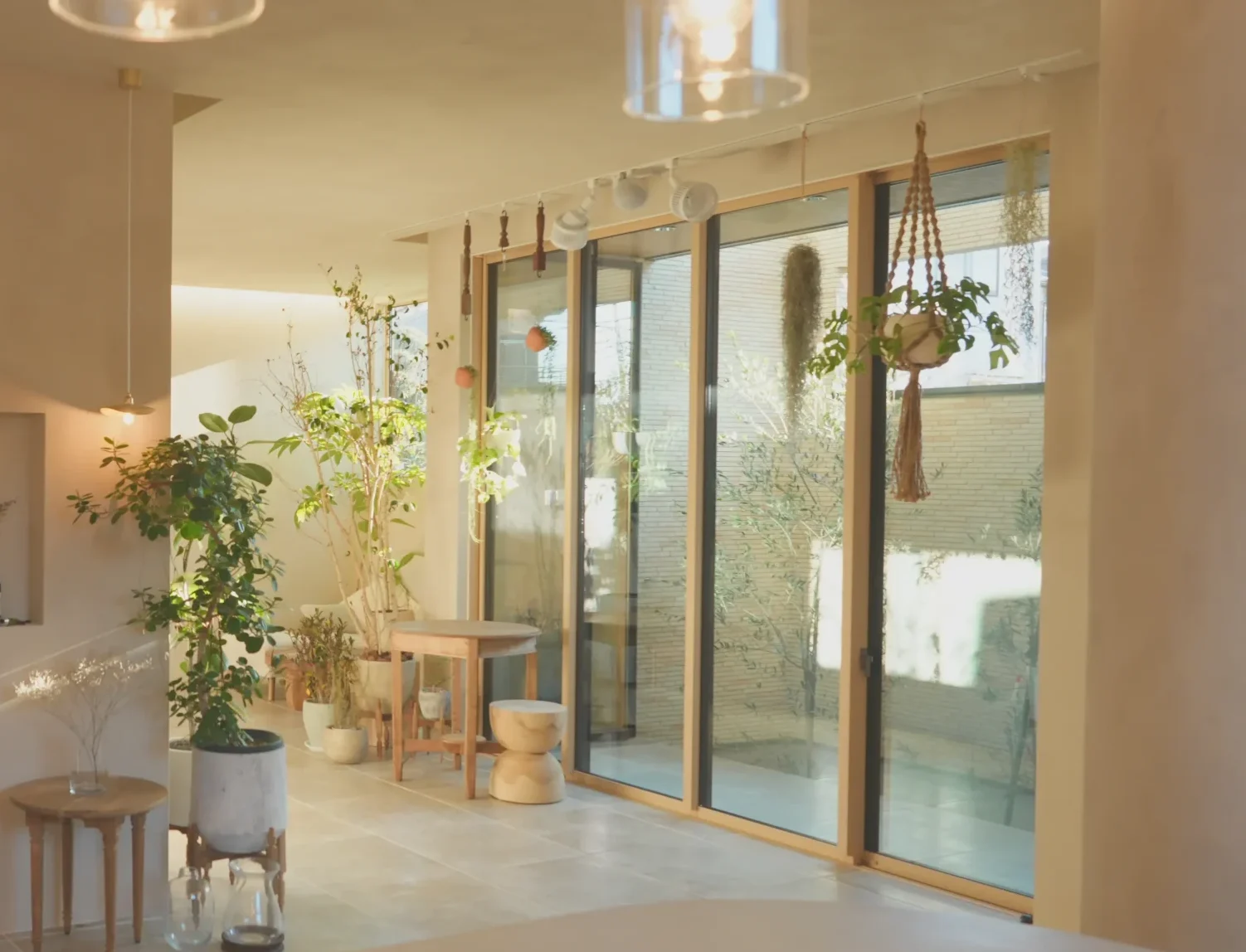
When planning a floor layout, many people dream of a “seamless, flat transition between the living room and the courtyard (or terrace).”
In wooden houses, like those built by Sumitomo Forestry, achieving a “perfectly flat” transition is generally said to be extremely difficult.
However, we found that it is possible to achieve a “nearly flat” state that doesn’t bother you in daily life.
Today, based on our experience building with Sumitomo Forestry, I’ll share the “step problem” between our living room and courtyard terrace, the mid-construction panic that ensued, and our honest thoughts on what we learned.
Why We Dreamed of a Perfectly Flat Transition
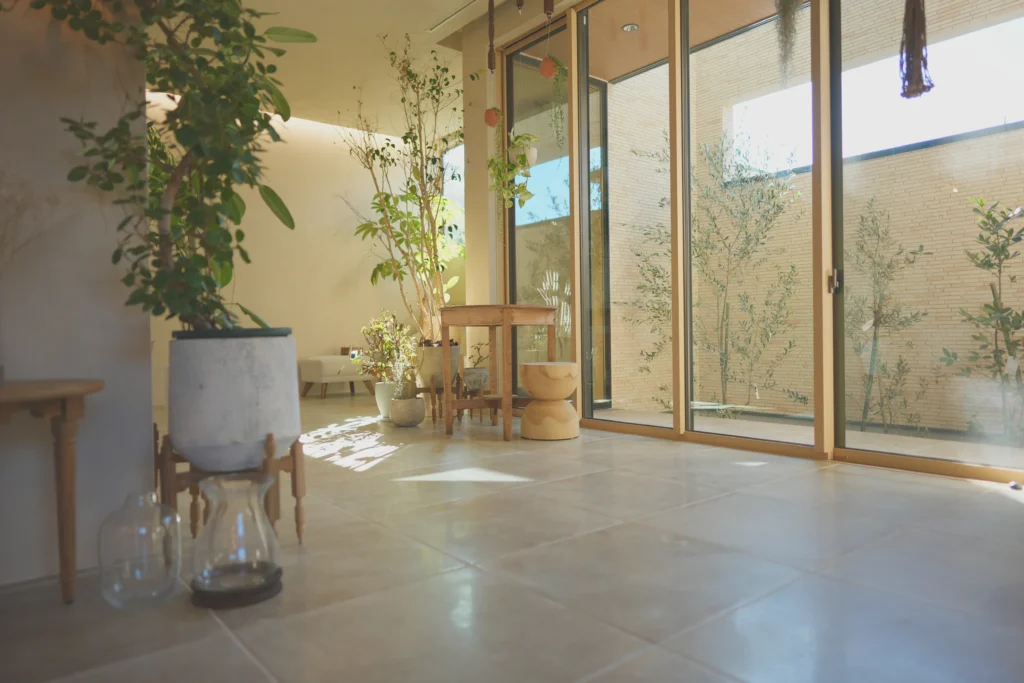
When we first started planning our home, we had a strong desire to “connect the living room and courtyard terrace completely flat.”
The beautiful spaces where the indoors and outdoors connect seamlessly, often seen at model homes and on Instagram.
We felt that just making it flat would bring so many wonderful benefits.
- Connects the inside and outside, creating an overwhelming sense of unity.
- Draws the eye outward, making the room look much more spacious.
- Eliminates the stress of tripping or stepping down when going outside.
“If we’re going to build a courtyard, we absolutely want to eliminate the step as much as possible!”
With that enthusiasm, we headed into our meetings with our architect.
The Harsh Reality During Meetings
However, early in our meetings, our architect hit us with something unexpected.
“Making it completely flat is structurally very difficult.”
“If we try to make it as close to flat as possible, it could cost over an additional 1,000,000 JPY.”
Honestly, at the time, we just sort of accepted it, thinking, “Ah, I guess that’s just how it is with wooden houses.”
We researched this later ourselves, and unlike steel-frame structures, wooden houses have several structural challenges to protect the building.
- Underfloor Ventilation: If you block the ventilation gaps (foundation packing) between the foundation and the building with a terrace, moisture can easily build up under the floor.
- Termite Prevention: If the ground (terrace) is too close to the wooden structure, the risk of termite damage increases.
- Water Leak Risk: A “water stop” (a step) is necessary to prevent water from coming over the window tracks and entering the house during heavy rain.
To overcome these, there is a construction method that installs “grating” (a metal mesh trench) between the terrace and the house.
However, in the case of Sumitomo Forestry, even if you install grating, a step of a few centimeters will structurally remain—meaning it won’t be “perfectly flat.”
We decided that spending over a million yen on something that wouldn’t even be completely flat wasn’t realistic for our budget. We reluctantly accepted a “step of about 20cm (approx. 8 inches).”
The Regret That Hit After Construction Started
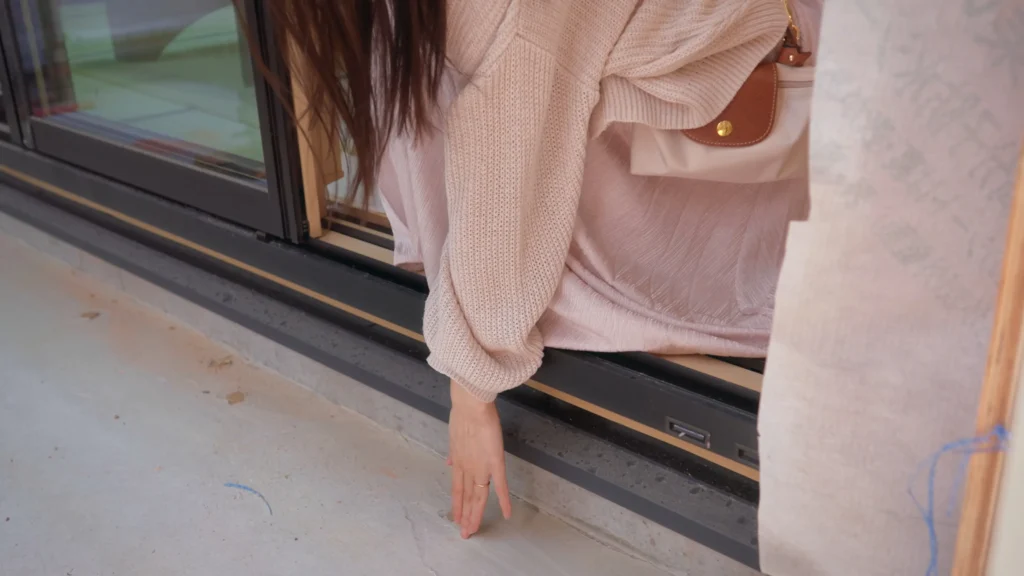
Construction safely began, and the structure around the courtyard started to take shape.
When we visited the site, we were hit by a massive wave of regret.
The “20cm step” appeared right before our eyes.
We thought we understood it from the drawings and measuring tape, but seeing it built in the actual space, it felt much larger than we imagined.
It was at a level where going in and out would feel like a bit of a chore.
“We really should have pushed to make it closer to flat, even if it meant stretching the budget…”
We were consumed by regret, but it felt like it was too late.
Realizing Our True Ideal at a Friend’s House
While harboring these mixed feelings, we happened to visit a friend’s house, also built by Sumitomo Forestry.
What we saw there was a courtyard terrace that connected “nearly flat” to their living room.
Looking closely, it wasn’t a true zero-step transition; there was a slight slope and a small step of a few centimeters around the window tracks.
But it was at a level that wouldn’t bother you at all in daily life—it was incredibly beautiful.
At that moment, it hit us.
“Oh, we didn’t need to obsess over it being ‘perfectly flat’.”
What we were truly after wasn’t a flawless space without a single millimeter of a step, but a “comfortable space where you feel a visual connection and can step outside without tripping.”
Asking for a Change (As a Hail Mary)
Having realized our true “acceptable range,” we immediately consulted our site supervisor.
Since construction was already somewhat underway, we had half given up, thinking, “It’ll be too hard to change it now.” But surprisingly, after checking the site, they agreed to get us a quote.
Furthermore, thanks to the site supervisor’s kindness, we were able to get competitive quotes not only from Sumitomo Forestry Landscaping but also from an external landscaping contractor.
After comparing the external contractor, the price difference wasn’t huge, so we ultimately decided to go with Sumitomo Forestry Landscaping. We are so grateful to our site supervisor for giving us the option to compare.
The quote they provided wasn’t the astronomical “over 1 million yen” we were initially told, but a highly realistic and acceptable amount.
“At this price, we want to do it!” we said, immediately requesting the additional work. As a result, we were able to change the specs of our courtyard terrace mid-build.
The Final Result & Our Honest Regret
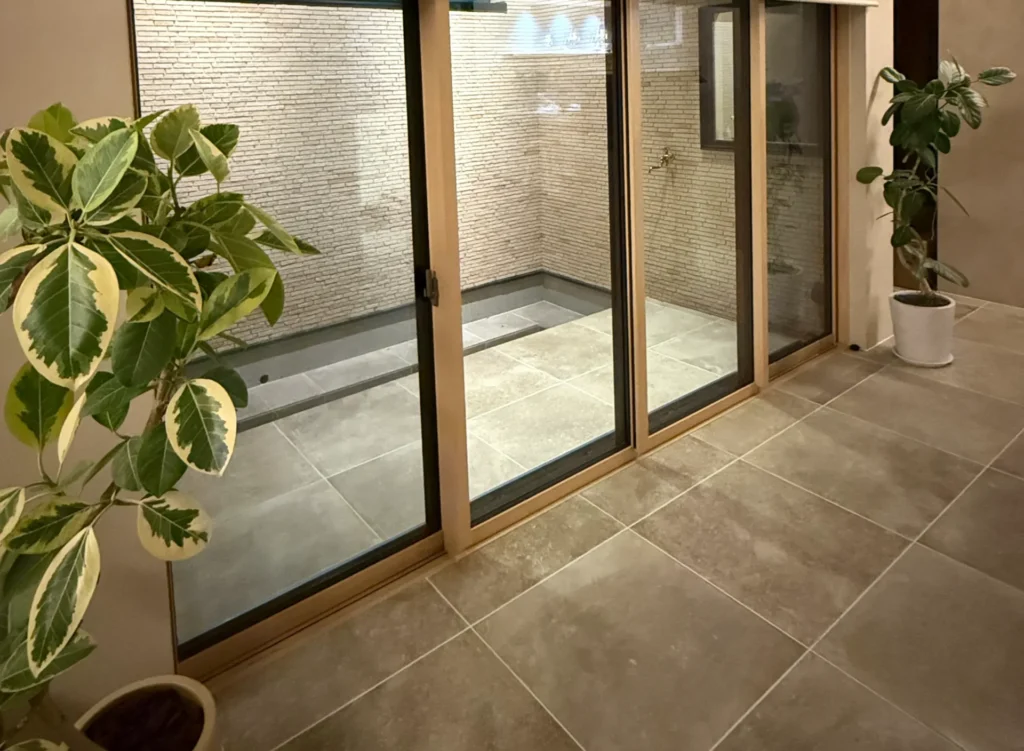
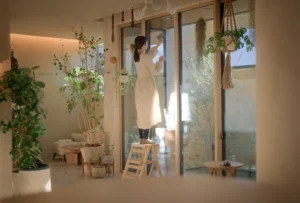
Here is our finished courtyard terrace.
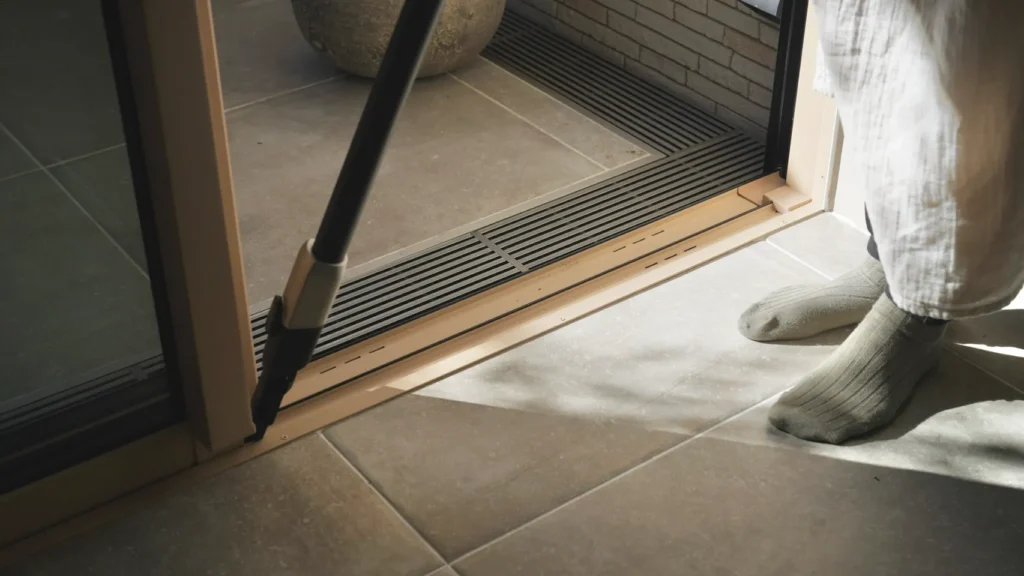
We asked for additional work to get it as flat as possible, but due to drainage slopes and waterproofing constraints, there is still a step of about 4cm (1.5 inches).
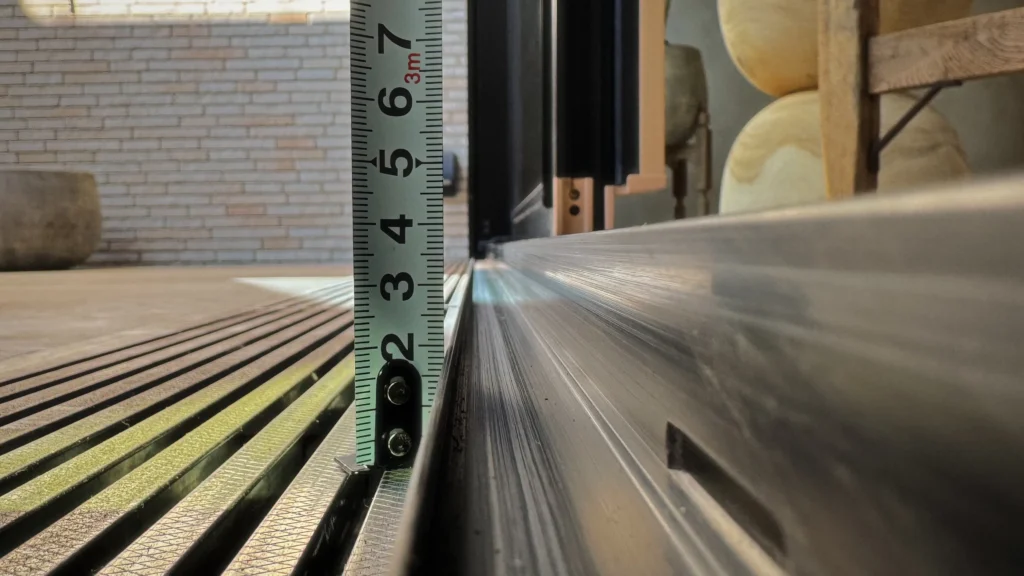
However, visually it looks nearly flat, and your gaze is drawn straight outside, making the whole space feel very expansive.
We sincerely feel that making the change, even with the extra cost, was totally worth it.
By the way, for the courtyard tiles, we chose Hirata Tile’s “Carriere.” We picked them for their texture that matches our plastered walls and their cute, slightly puffy grout lines. But we also discovered a happy bonus: the pattern hides dirt incredibly well!
The Small Regret That Still Lingers
However, there is one thing I honestly regret.
That is, “We should have discussed this more deeply during the design phase.”
- If we had communicated from the start, “It doesn’t need to be perfectly flat; we can accept this much of a step,” they might have come up with different design solutions.
- It wouldn’t have been an “additional construction” cost, and we might have been able to incorporate it better into the overall budget.
- Our options, like the choice of window frames, might have been much broader.
I feel that giving up so quickly just because we heard “perfectly flat is impossible” ultimately led us down a longer, more stressful path.
Two Things We Learned from Building Our Home
Through this “flat floor” problem, we realized something incredibly important about building a custom home.
Know Your Acceptable Range
When looking at social media, you often see strong phrases like “Perfectly flat!” or “You absolutely MUST do this!” Seeing that makes you feel like you have to aim for a “perfect 100/100.”
However, real-life home building has much more of a gradient.
We learned that rather than straining the budget to achieve perfection, identifying “the line where we can live comfortably” leads to a much more satisfying home build.
When in Doubt, Always Get a Quote
When an architect gives you a verbal estimate saying “That will be expensive,” it’s often a rough guess based on past experience, or the “maximum cost assuming you aim for a perfect 100.”
If you have even the slightest hesitation, we highly recommend asking for a specific quote, saying, “Well, how much would it be for this (80/100) spec?”
It might increase the number of meetings and slightly delay your decisions, but ultimately, it will lead to confident choices that reduce regrets.
Conclusion
- With Sumitomo Forestry (and wooden houses in general), “perfectly flat” transitions are often structurally difficult.
- However, a “nearly flat” transition that doesn’t bother you in daily life is likely possible.
- Don’t strive for perfection; it’s crucial to decide your own “acceptable step height.”
- Even if you’re told it’s “difficult” or “expensive,” don’t give up immediately—always get a specific quote.
Building a home is an endless series of decisions, but I hope this helps reduce your doubts and regrets even a little bit.
\ The First Step to Building Your Home /
If you are just starting your home-building journey, we recommend requesting catalogs from multiple builders to compare “your acceptable lines” and “each company’s specialties.” We also started by doing a bulk catalog request!
We Also Show the Actual Space on YouTube!
You can see the “nearly flat” connection between our living room and courtyard in detail in our room tour video.
Please check it out to get a feel for the actual vibe!

Comments